09 March 2006

Packwood - The Excitement Builds

Regular readers may remember that way back in February of last year I Googled my own name (see "Snatched By Vanity" in the archives), and was delighted to discover the existence of a town in Washington state called Packwood, in , wait for it, Lewis county. Yes, that's right ladies and gentlemen, they finally named a town after me.
 
Ever since then I just can't stop thinking about Packwood (WA). I often find myself absent-mindedly surfing the net, looking at pictures of Packwood's shops and bars, along with eruption forecasts for nearby Mt. St. Helens and prices for snowmobile rental: I just can't get the place out of my head. There's only one thing for it - I'm gonna have to go to Packwood.
 
That's right folks, the prodigal son is returning home. Come August I will be setting foot on the hallowed soil of Lewis county. What will the locals make of me? Will I be shunned as just another eccentric travelling Englishman? Or will they receive me as their one true heir and crown me as the mighty King of Packwood? Who knows. But I can't bloody wait to find out.
 
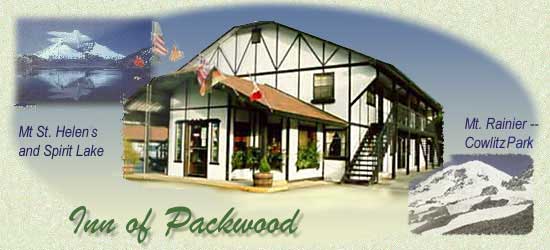
Seriously, I am SO excited about visiting Packwood. I've just been having a look at it on Google maps. Guess what - Lewis Road runs straight through the middle of Packwood! How cool is that! The more I research things about Packwood, the more fascinating it becomes. I've just been checking out the website for the Inn of Packwood: I love their catchphrase:
 
Whatever your pleasure, INN OF PACKWOOD is the "in" place to stay while in the beautiful Cascade Foothills.
 
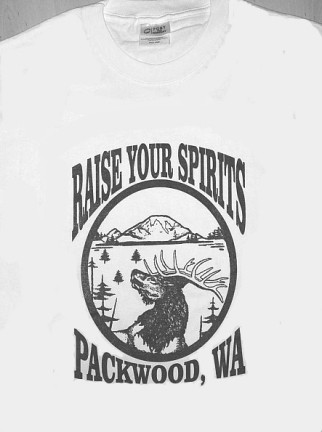
Classic. Then there's Packwood Spirits and Mementoes right next door, a shop selling traditional wood carvings and absorbant coasters, as well as "competitive priced cigarettes and adult beverages". Best of all though, they sell Packwood T-shirts (see below). I'm ordering one right now.
 
Man, I can't believe I'm actually going to see these places with my own eyes in a few months time!!!

The Inn of Packwood - proud bearer of a five star review on Yahoo Travel. One happy customer said: "We had travelled and stayed at several places in the past but never experienced such a clean and hospitable place to live." Book me a room, I'm on my way.

The Official Packwood T-shirt. I'm currently making enquiries about overseas delivery.

06 March 2006


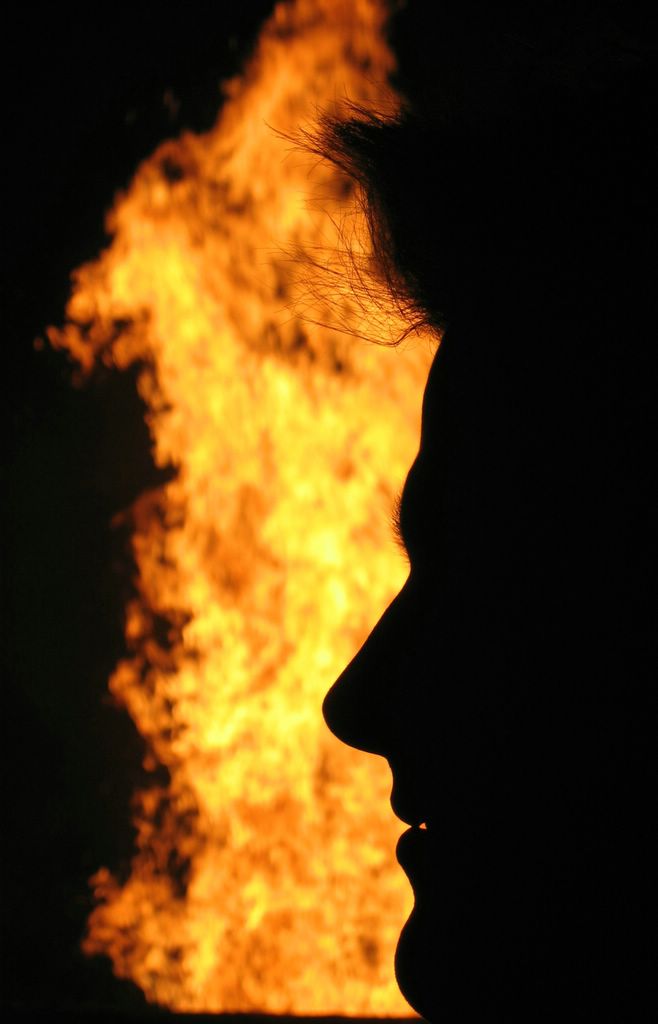
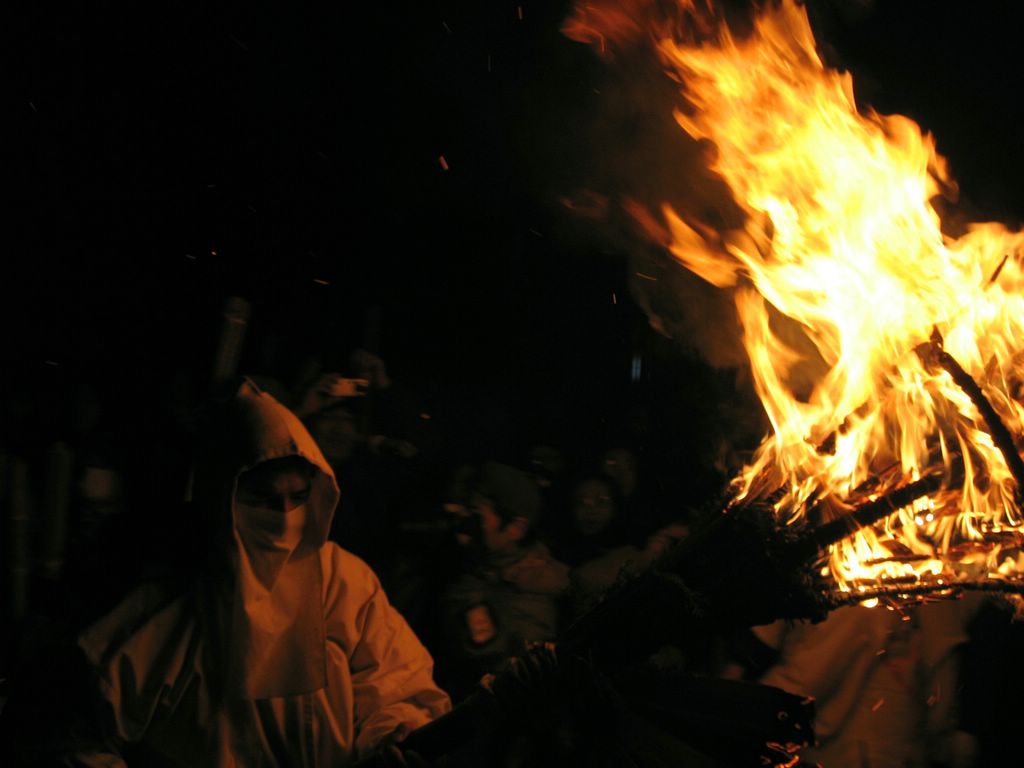
Doug silhouetted against the bonfire at the Omizuokuri festival.

Holy Burning Braziers Batman!!!

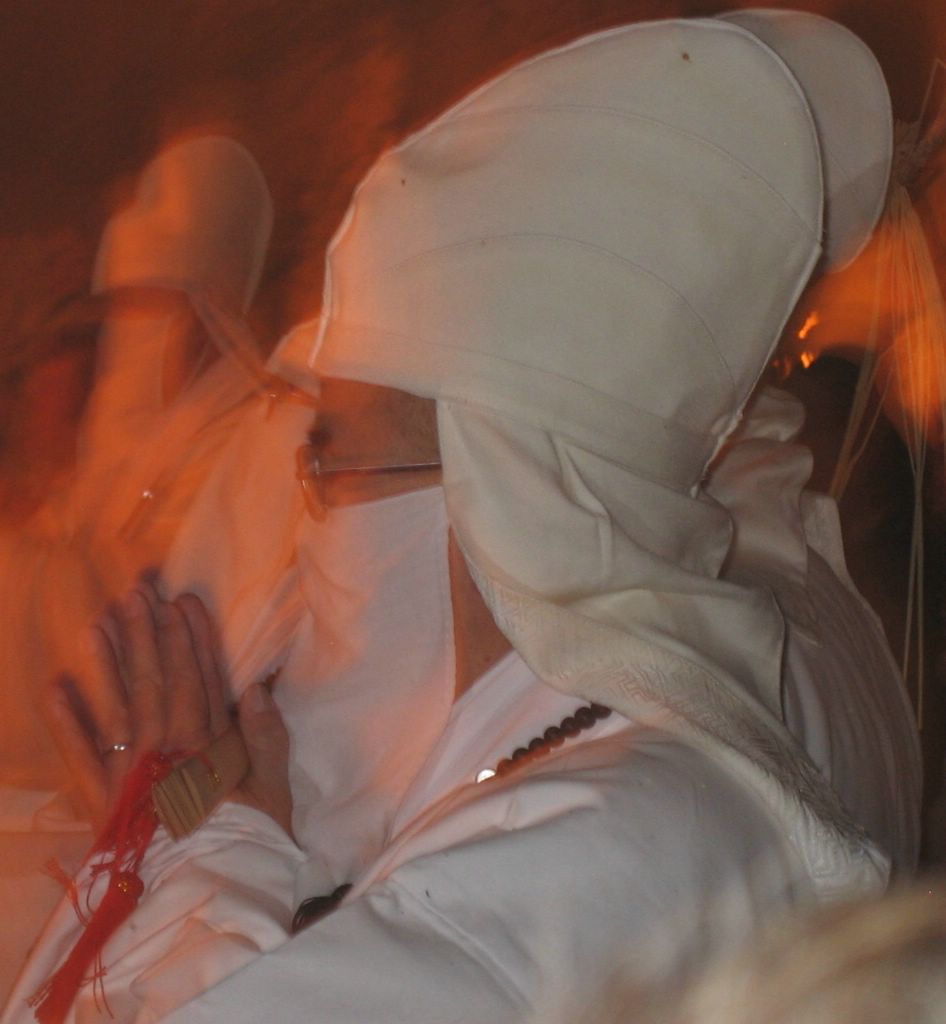
I witnessed a truly strange and fascinating spectacle last Thursday - the "Omizuokuri" ("Water-sending") festival in Obama, in southern Fukui. Probably the strangest part of the festival was watching men dressed in pointy white robes lead a procession of people carrying burning torches - I probably don't need to spell out what that reminded me of. Needless to say though, any similarity between this ancient Japanese festival and the infamous KKK is purely coincidental.
 
It still looked mighty weird though.
 
The history of the festival is even stranger: believed to be around 1,200 years old, the ritual dates back to a priest known as Jitchu Kasho. Here's a summary of the festival's history, taken from the Kansai Window website:
In the Nara period, the legend goes, Jitchu Kasho asked the gods from all parts of Japan to attend the shunie [rite] at Todaiji's Nigatsudo [a temple in Nara]. Onyu Myojin of Wakasa [now southern Fukui] arrived late for the gathering, however, because he had been busy fishing. Myojin deeply regretted his lateness and by way of apology promised to offer kozui (aromatic water) from Wakasa to Nigatsudo's principal image. With those words, a black and white cormorant (a black cormorant and a white cormorant) flew out of a rock in Nigatsudo and water began to pour forth from the rock: Wakasa water. Thus the name of the Wakasa well [in Todaiji temple] derives from this legend.
To commemorate the miraculous emergence of Wakasa water in Nara, every year the event is recreated by priests at Jinguji temple in Obama. The priests "send" the water to Nara by pouring it into the Onyu River at "Unose" (Cormorant Rapids), and 10 days later a sister festival is held at Nigatsudo, where the water is drawn up from the Wakasa Well. Obviously though, it's not the same water that was poured into the river in Obama. Or is it? Or IS it? OR IS IT?
 
Considering it's a water festival, it certainly featured an unhealthy amount of fire - we're talking giant bonfires and ten foot long braziers stuffed with kindling (though not the kind of braziers you're thinking of) along with hundreds and hundreds of people carrying lighted torches - think Bonfire Night, but with bigger sparklers. Luckily though, there were several men wearing helmets who were carrying batons with red, flashing lights, so I felt perfectly safe. Hooray for men in helmets with batons!

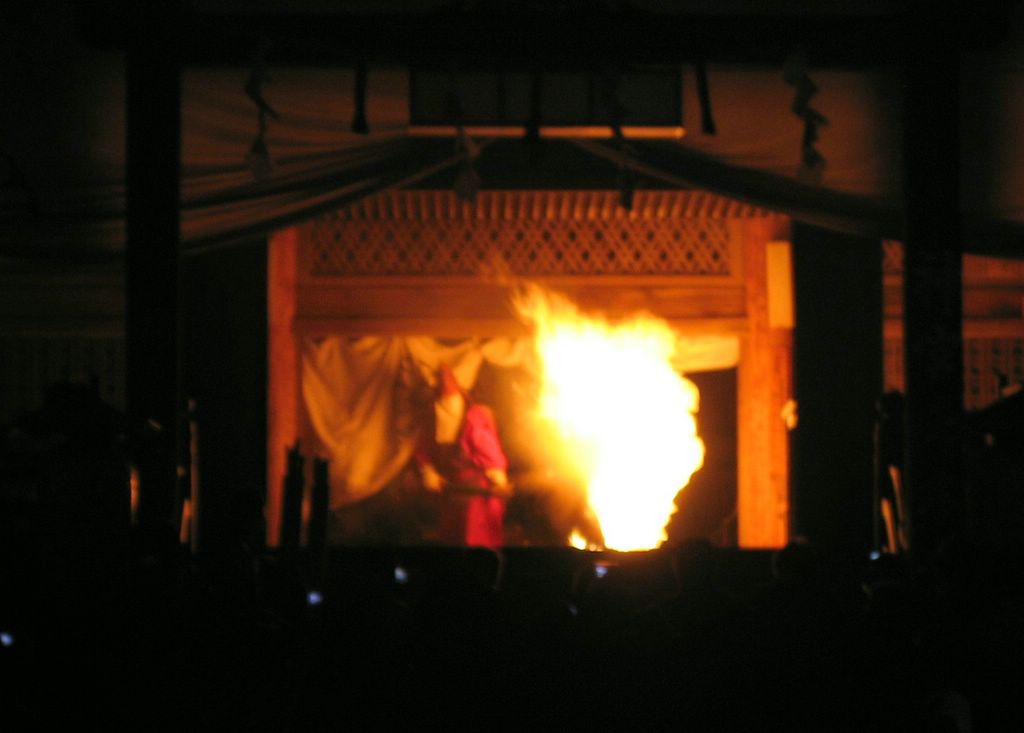
Strange noises begin eminating from the shrine, which is the signal that the ceremony has begun. After a little while you realise that the noises are in fact footsteps, caused by a man running from one side of the shrine to the other, pausing only to jump up and down in the doorway. It's quite spooky in a bizarre way. Then this priest dressed in red lights a huge torch INSIDE the shrine, and proceeds to drag it around INSIDE the shrine for several minutes, before emerging at the doorway. No wonder so many temples and shrines have burned down in Japan.

After the mysterious priest in red has finished attempting to burn down the shrine, the torch is carried past the crowd and used to light an enormous bonfire. As the torch is carried forwards, a dozen or so white-robed priests emerge, along with a sort of "band" who start blowing conch shells, and suddenly it all begins to feel a little tribal. The crowd then chants "Kill the pig, Spill its blood", and a rotund boy with glasses runs for his life. Maybe. Anyone read Lord of the Flies?

The first bonfire is lit. Now that's what I call a conflagration.

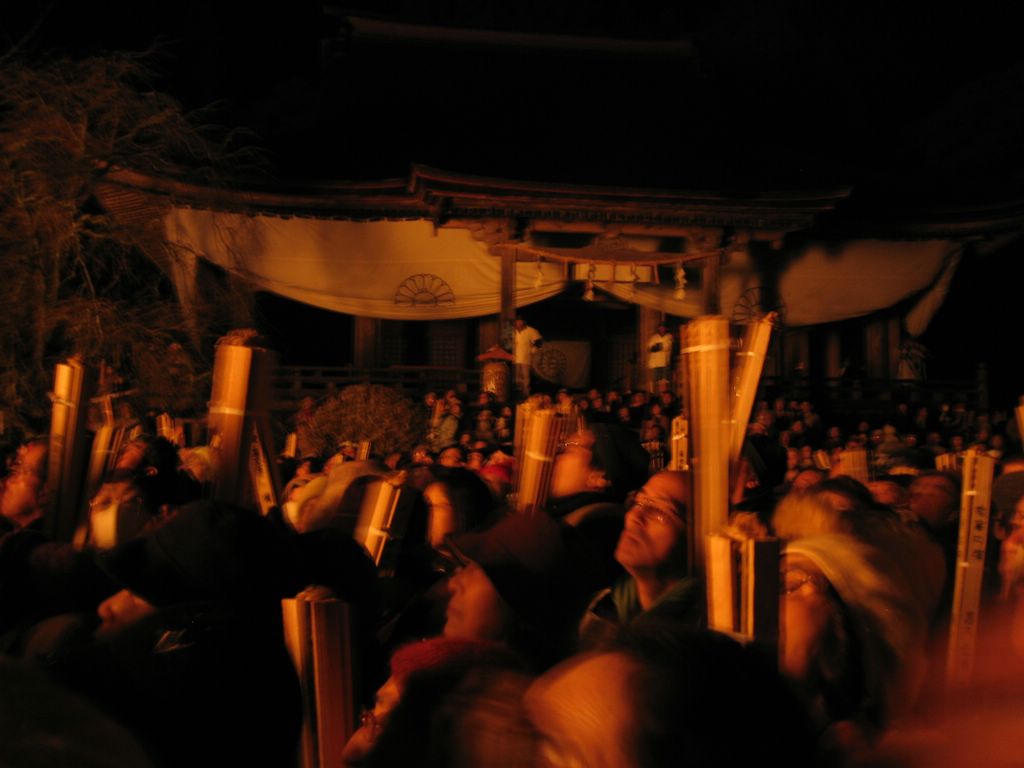
The crowd in front of the shrine surges forward to watch the rites taking place by the bonfire. I couldn't see very much, but there was plenty of sword waving going on, and at one point a priest shot an arrow into the crowd. I must say I was a little alarmed at that particular development, but I think the arrow was made of balsa wood or something since no-one called an ambulance.

Before the ceremony we bought this torch. The idea is to write a wish on it, along with your name, then if you're lucky the torch is cast onto the second bonfire by the river, and your wish will come true. We chose to wish for Sekai Heiwa (World Peace). In this photo "Team Peace" - consisting of Doug, Colin, Tina and myself - have just lit their torch of hope from the first bonfire by the shrine. Go Team Peace!

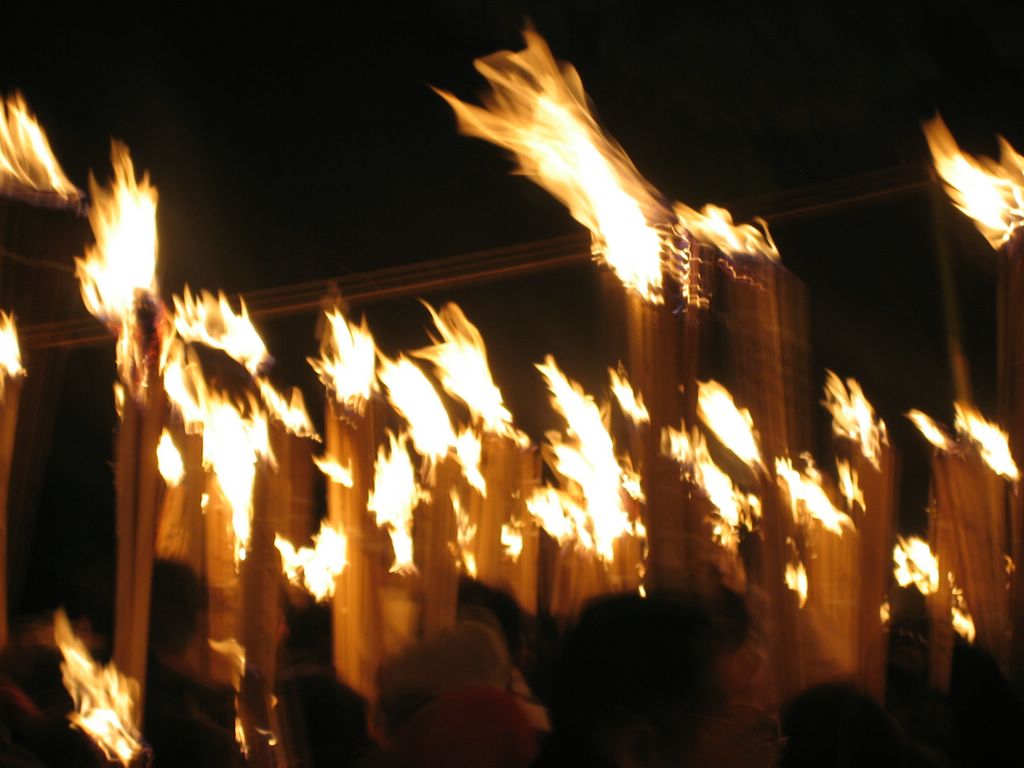
A procession of worshippers holding torches forms as everyone marches down to the river. This was an amazing sight - hundreds and hundreds of people making a ribbon of golden flames snaking across the dark countryside.

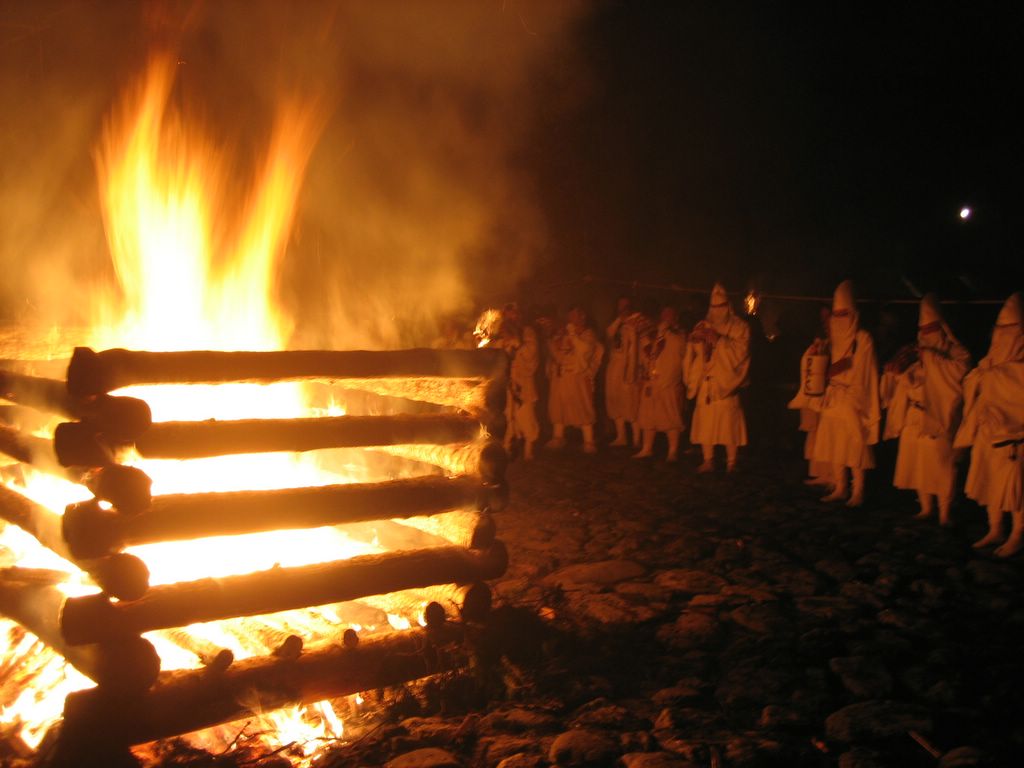
Eventually the procession reaches "Unose" ("Cormorant Rapids") about 2 km away from the shrine, and a second bonfire is lit. Here you can see the priests' pointed white costumes.

A circle of priests chant as offerings are thrown onto the bonfire, including many of the extinguished torches which have been carried to the river by the crowd. Did "World Peace" make it onto the fire? Who knows...

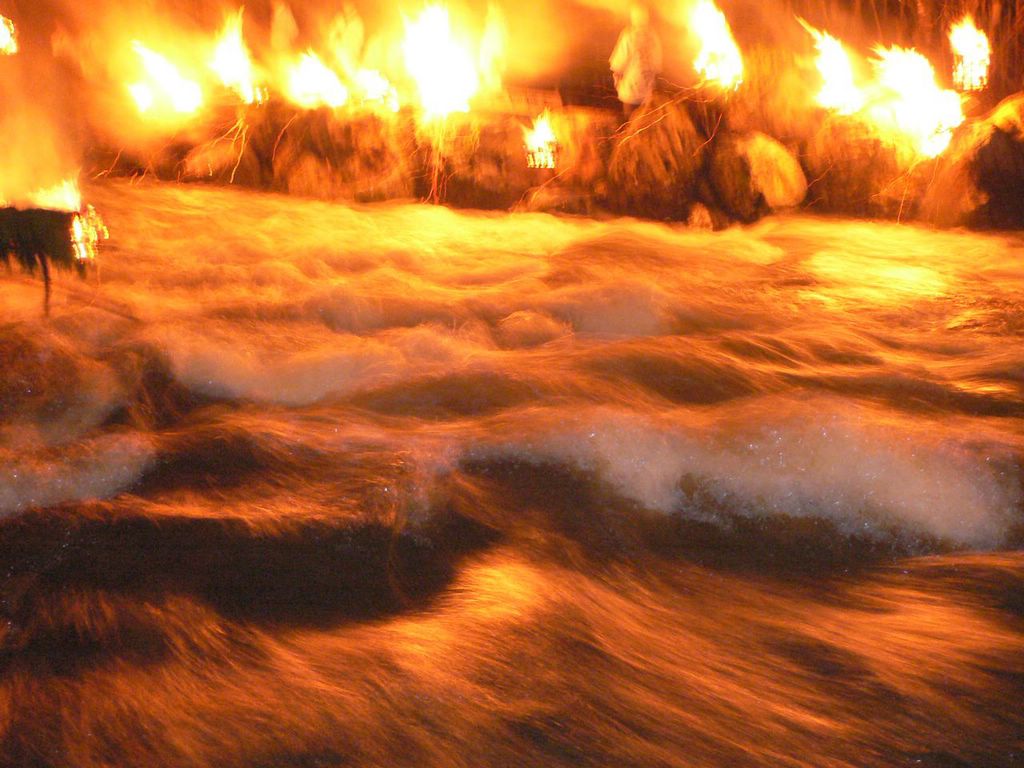
The festival reaches its climax when the head priest pours the sacred water into the raging torrent, as sparks from the burning torches "purify" the river. Ten days later the water is said to reach Nara, where the "Omizutori" ("Water-drawing") ceremony takes place. (This photo courtesy of Colin Johnston)

02 March 2006


"That's it, keep smiling, keep smiling, no funny business. This gun's loaded you know, and I've got it pointed right at your spleen - just look good for the camera or it's the last thing you'll ever see, Sonny Jim. Thought you could escape did you? You should know by now... THERE IS NO ESCAPING THE SOTSUGYOUSHIKI. Mwahahaha!!!"

The Annual Student Banishing

Today was a very special day at school. Since it's the end of the school year, all the students are herded into the school gymnasium for what's known in Japanese as the "Sotsugyoushiki" or "Punishment Ceremony". This yearly event is primarily designed to punish the entire school for everything they've done wrong in the past year, from running in corridors to falling asleep in class. Ironically, around 10% of the students actually fall asleep during the ceremony itself.

The ceremony is particularly hard on the third years. A list of their crimes is read out, after which each student must stand up and shout "Hai", (meaning "Yes, I did it"). Then, at the end of the ceremony, the third year students are summarily banished from the school forever, as the rest of the school and staff applaud them mockingly. Having experienced the Punishment Ceremony two times previously, many of them simply cannot take the gruelling ordeal for a third time, and throughout the proceedings individuals will spontaneously burst into tears for no reason. It's a harrowing sight.

After being forced to decorate the school in red and white (symbolising blood and sweat) the students are made to endure temperatures as low as 5 degrees for up to two hours, wearing nothing but a thin, nylon school uniform and sandals. Local dignitaries and teachers sit either side of the student body, chiefly to block their escape route. After the the List of Crimes is read out the students are numbed into submission by half a dozen or so brain-destroyingly dull speeches, designed to sap the listeners' will to live. Once the verbal bombardment is over with, the students' minds are once again malleable enough to endure another year of conditioning. I mean "education". For the unlucky third years though there is nothing left but the long walk of shame into Cursed Earth which lies beyond the school gates...

As for me, I was faced with a stark choice. As part of my role as prison guard I must also endure the intense cold, but how best to overcome it? The solution lies in something called "hokairo".

A long time ago Japanese heating inventors took an unorthodox path in the "making things warm" industry. Rather than choosing to make whole rooms warm (by using say, I don't know, "central heating" or something) they decided instead to leave the rooms cold and just make everything else warm. Hence the reason why we have heated tables ("kotatsu"), heated toilet seats and heated carpets, but no radiators. The most extreme development of this "let's heat everything except the room itself" policy is the hokairo, which consists of a pad filled with a gel-like substance which heats up the moment you remove it from the packet. The hokairo can then be stuck to any part of the body which needs a bit of heating.

These things saved my life during the Punishment Ceremony. I'd learned from my near-fatal freezing experience at last year's ceremony, and decided to stick six of the pads on my hands, feet and lower back, ensuring I was toasty-warm all throughout the castigation.

Well, my hands, feet and lower back were warm anyway, the rest of me was freezing. Hooray for hokairo!

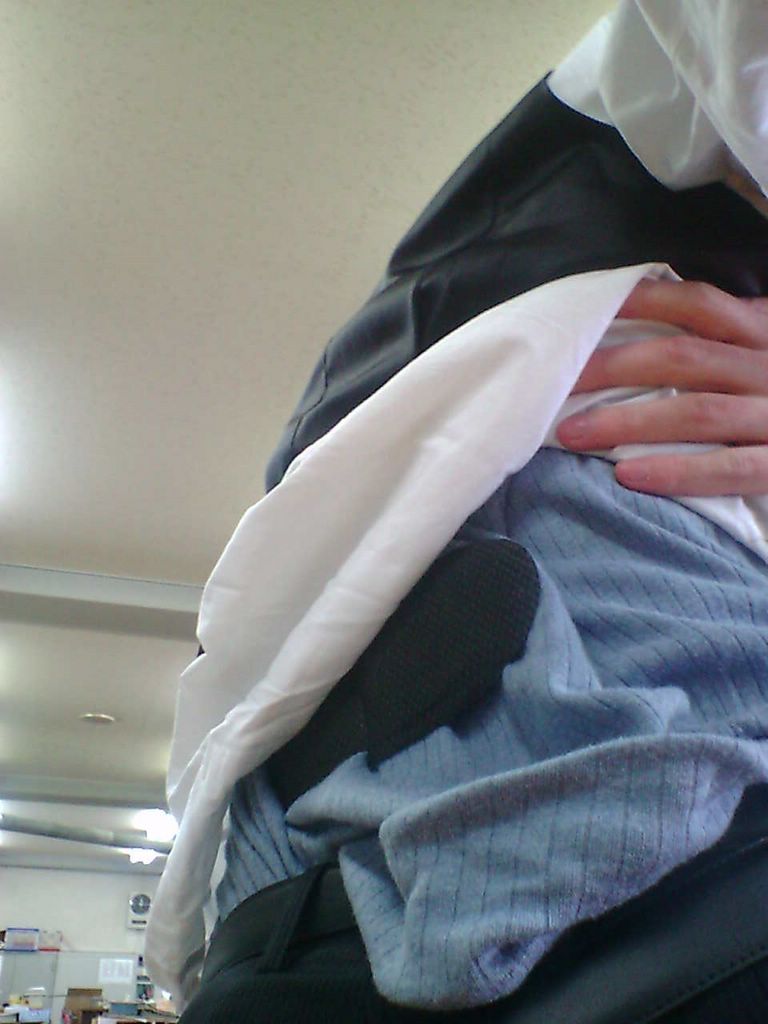
May I present my "Tribute to Hokairo" - the unique body-part-specific heating system. Here you can see me modelling a pair of hokairo worn in the popular "lower back" position. Notice also the thermal vest - I'm no fool, I'm not just relying on magic gel-filled pads to keep me warm.

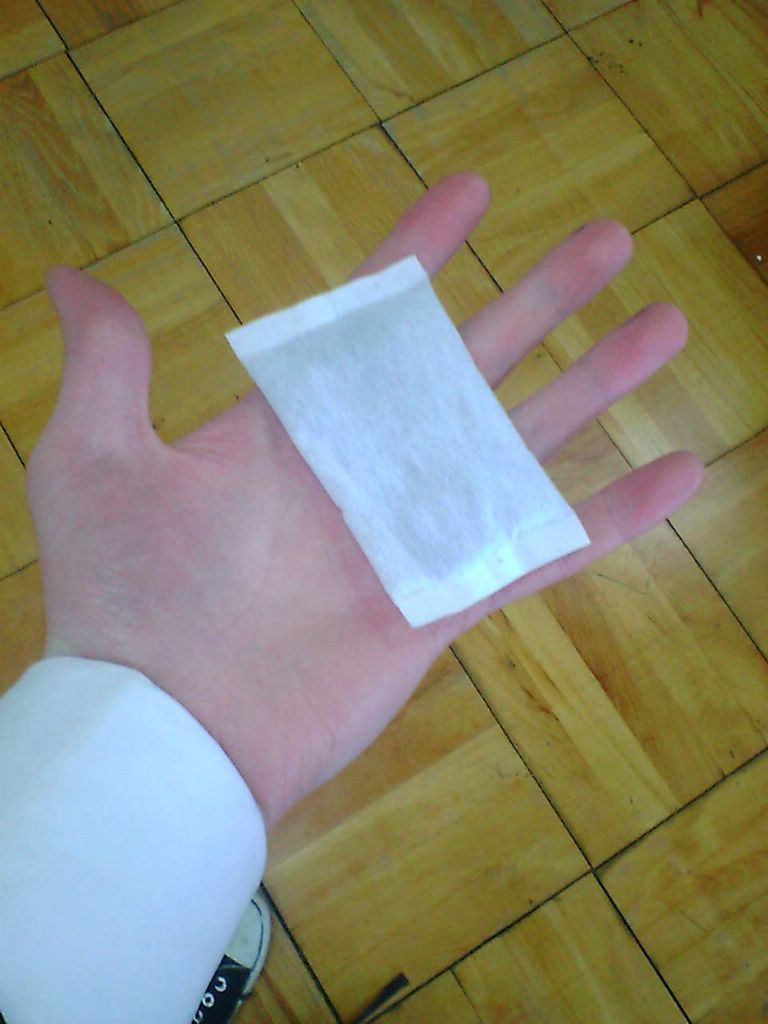
Then there's this delightful "pocket hokairo" which can be clutched tightly for warmth in those hard-to-reach extremities...

...and lastly we have the "kutsushita hokairo" for the feet. So my feet and hands were wonderfully warm as my ears froze and dropped off.

This was the "Punishment Lunch", given free to all teachers. As you can see, the meal consists almost entirely of meat and fish, which is my punishment for being a picky vegetarian. The cherry tomato was delicious though.