25 October 2005


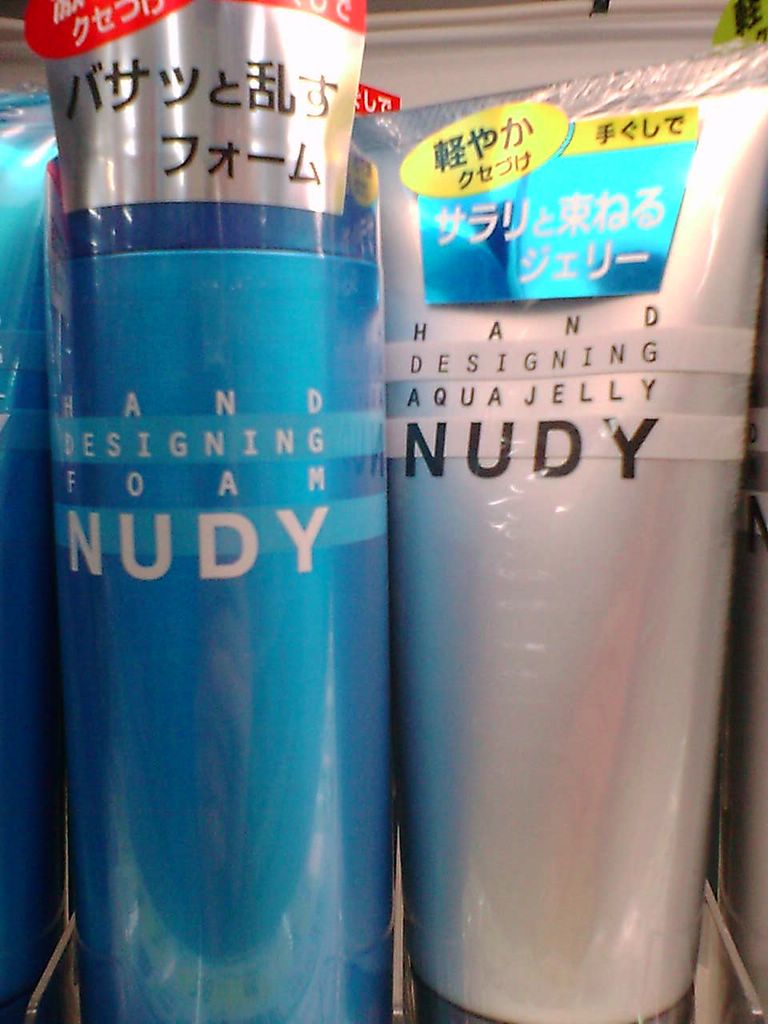
"Hand Designing Aqua Jelly NUDY". Lord knows what this stuff does, but I can honestly say I have no wish to re-design my hands.

This has to be my favourite: a "hair liquid" called "Mandom". It's like the seventies never ended - you can just see this sitting happily on a shelf next to a can of "Brut" and some "Grrr!" aftershave. It's probably advertised by Joan Collins.

24 October 2005

Congratulations!

I just wanted to say congratulations to my friends Paul and Jenny, who
got married this weekend. Congratulations! I was so disappointed that
I couldn't make the ceremony - I really really wanted to be there.
It's at times like this when I realise just how far away from home I
actually am...

Still, I'll be back for a couple of weeks at Christmas, so hopefully
I'll be able to catch up with everyone then. I can't believe it's been
a year and a half already... How time flies when you're teaching
English to sleeping teenagers.
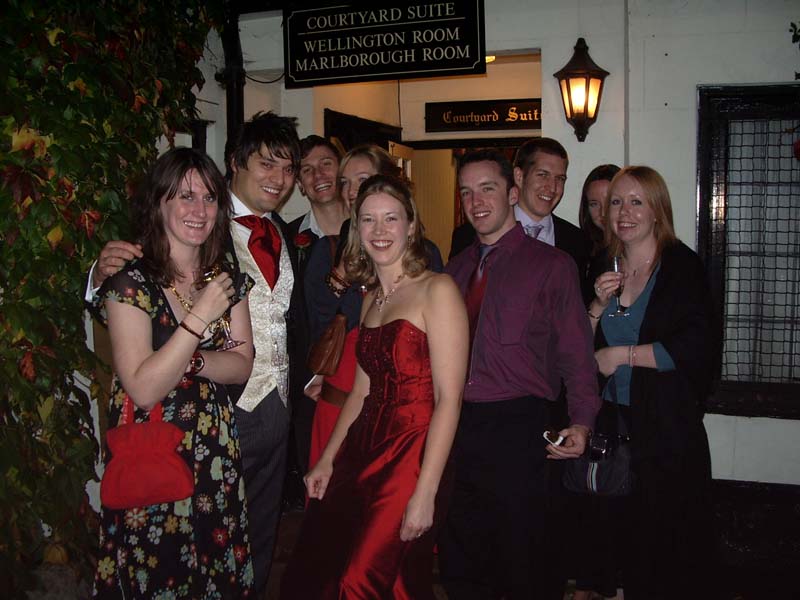
Jenny and Paul tie the knot.

Look at that - a pub. Not only did I miss out on seeing these lovely people get hitched, I also missed out on sinking a foaming pint of nut-brown ale in this fine establishment. Oh, the cruelty! Ale! How I miss thee! (From left to right: Steph, Paul, Simon, Amy, Jenny, Tim, Mark, Tanya and Laura)

19 October 2005


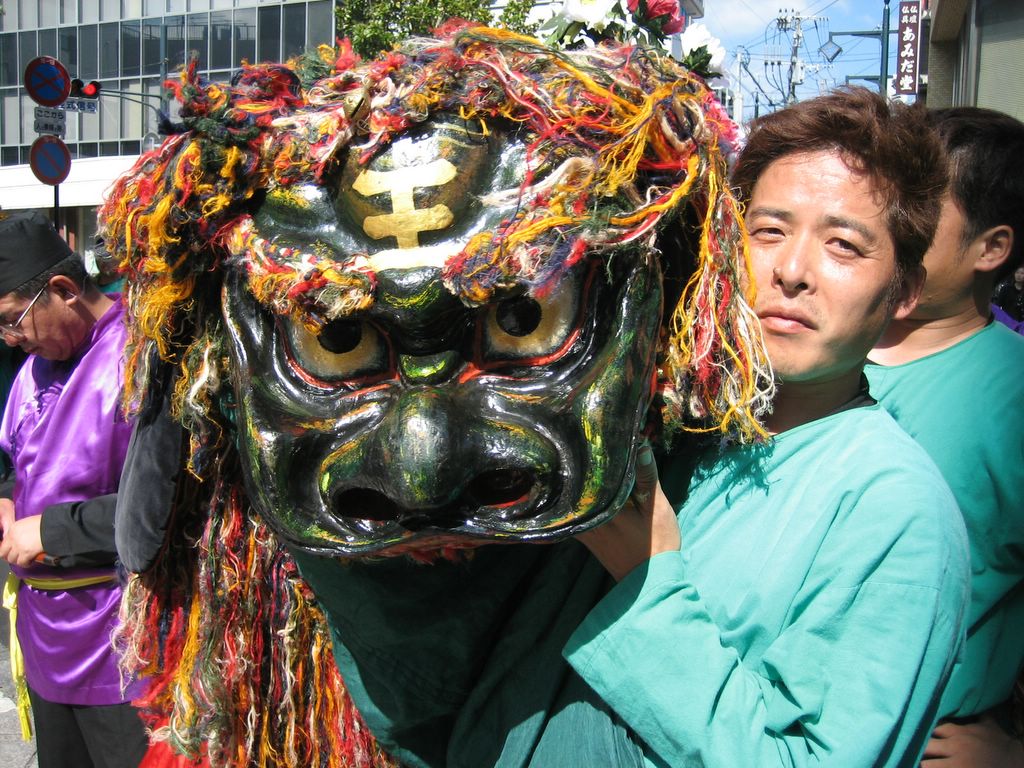
One of the lion dancers at the Kunchi Festival poses with his mask.

Nagasaki

It's a long, long way to Nagasaki. Not to mention expensive: return tickets for the shinkansen (bullet train) were around 40,000 yen for a return - that's about 200 pounds in the Queen's money. On the other hand we did get to travel on the "Nozomi", the fastest train in Japan, which travels at a top speed of about 300 km/h. It was absolutely incredible, like riding in a very low-flying plane weaving in and out through the mountains. It was so smooth and quiet too... man, it's going to be such a shock to go back to England and travel on those noisy old rust-bucket trains again.

Anyway, we travelled to Nagasaki for the Kunchi Festival, which is rightly regarded as one of the three best festivals in Japan. For three days the entire city is entirely taken over by teams of dancers who wander the streets, pausing to perform outside shops and businesses and generally make lots and lots of noise. Our first taste of the chaos happened in a bar just by the station - we were treating ourselves to a well-deserved beer after seven hours on the train, when a dragon wandered down the street and poked its head through the door, accompanied by a small army of children playing cymbals and drums. And things only got weirder from there...

The best thing about the Kunchi Festival is the variety of the performances. Most Japanese festivals stick to the same kind of formula: a bit of traditional dancing, some shrine carrying and a spot of karaoke for good measure. However, Nagasaki was the only place in Japan which was open to the west during the country's period of isolation from 1635 to 1853, and the festival draws on the many foreign influences that form the city's history. As a result some of the performances have a distinctly Chinese flavour, such as the dragon and the lion dancing, whilst the city's Dutch heritage can be seen in the "Hollander Boat" (a miniature sailboat which is dragged around the city flying the Dutch flag). It's all absolutely crazy stuff - I highly recommend you to go to the festival next year if you get the chance (if you're interested, you can find an interesting account of the 2000 Kunchi Festival, along with some good pictures, here).

We also took some time to wander around the Atomic Bomb Museum and the Peace Park in the north of the city. The museum was fascinating, although incredibly depressing. The bomb was dropped on Nagasaki on August 9th 1945 - three days after the first atomic bomb was dropped on Hiroshima. Out of a population of about 240,000, 73,884 people were killed and 74,909 were injured, with many suffering from horrific burns - in severe cases the skin came off in sheets, revealing the bones underneath. Almost everything within a 1km radius of the blast was completely flattened, and bottles and coins melted together in the intense heat, whilst humans were instantly carbonized. Looking around at the city now, it's almost impossible to imagine the destruction that took place there 60 years ago.

I think the Peace Park and museum were a fitting monument to those who died in the bombing - there was definitely a tangible sense of reverence in the air. I wasn't too sure about the main statue in the Peace Park though (see photo below) - in a way I kind of like it, but at the same time it has none of the impact that the A-Bomb Dome in Hiroshima has (you can see a picture of the A-Bomb Dome on Sam's blog).

I really enjoyed Nagasaki - the European and Chinese influences on the city are pretty obvious as you walk the streets, giving the the whole place a cosmopolitan feel which is missing in most other Japanese towns and cities. That's not to say Asahi is totally lacking in cosmopolitan feeling of course - we do have " Native American Factory HOPI". For what it's worth.

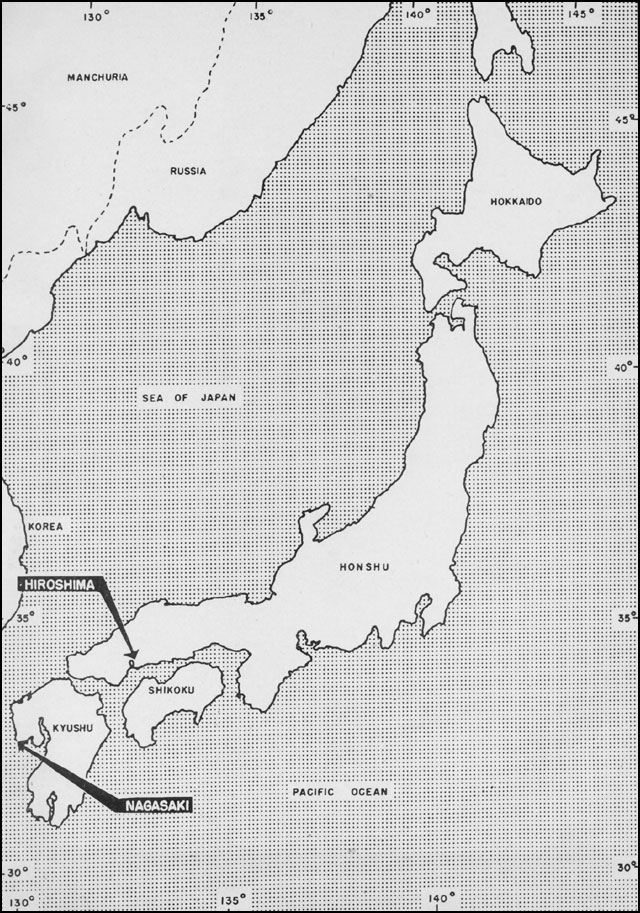
Here's a map showing the location of Nagasaki and Hiroshima. Fukui is about halfway up the west coast of Honshu.

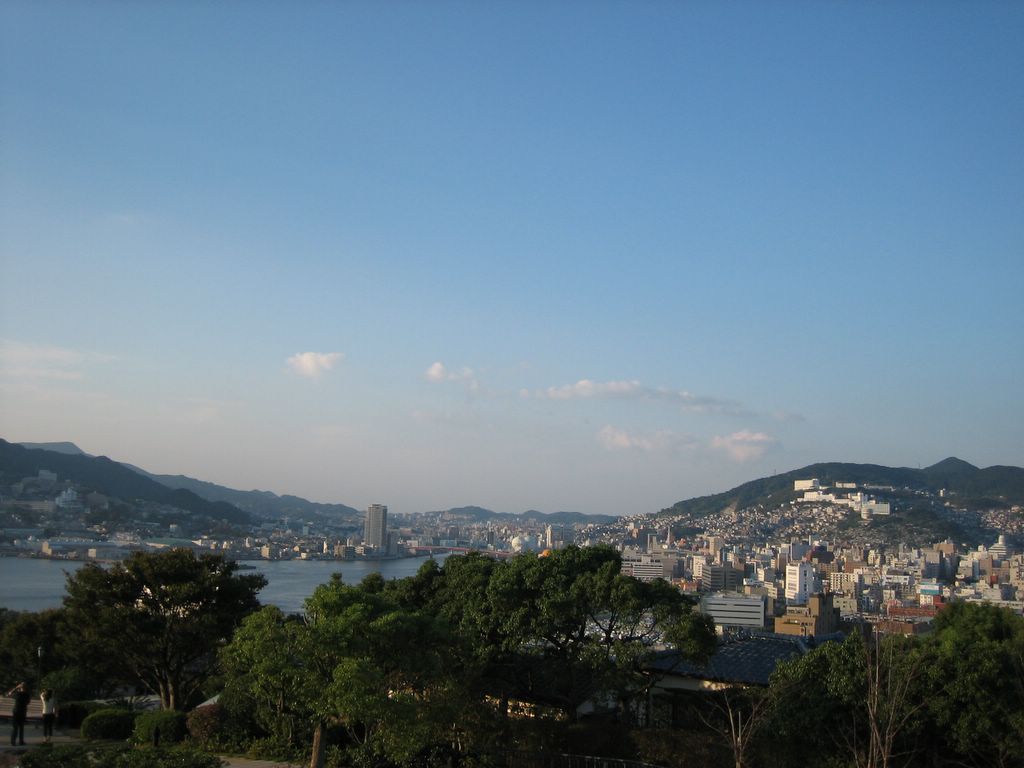
One of the best things about Nagasaki is its setting - the hills really give the city a lot of character.

Watching the dragon dance was probably the highlight of the festival for me. I took this photo just after the dragon had invaded a police station, much to the amusement of the local bobbies.

These cheeky young scamps were following the dragon around town, crashing cymbals and giggling at foreigners.

This "riverboat" full of young children playing musical instruments was spun round as quickly as possible, to the delight of the crowd. After the initial spinning, the audience begged for three more encores. Disappointingly, none of the children threw up.

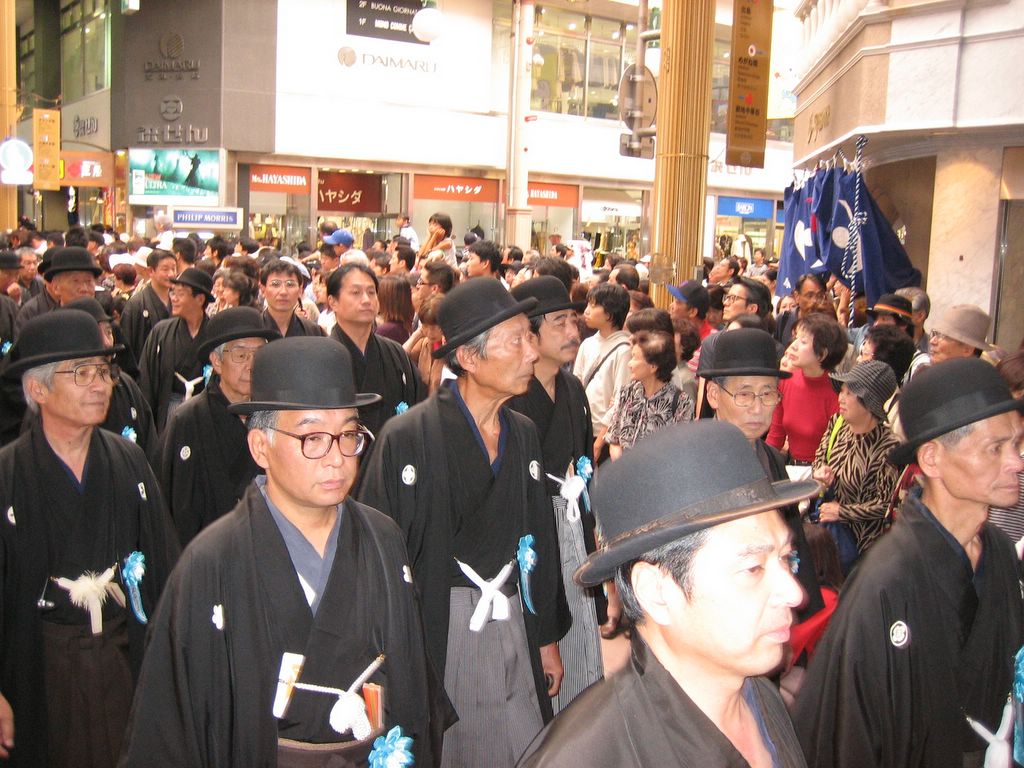
For some reason, old men in bowler hats and kimonos played a large part in the festival, although I have no idea why. Perhaps some sort of tribute to banking?

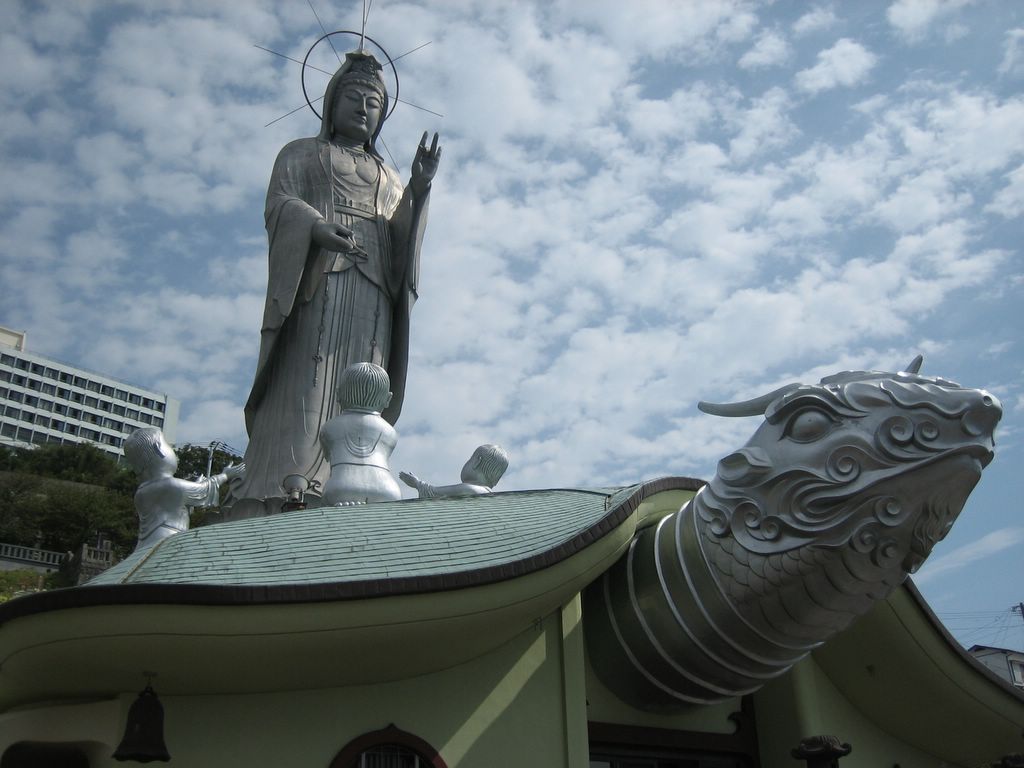
This odd-looking building is Fukusaiji - a Chinese temple which originally dates from 1628, but was reconstructed after the war to honour the victims of the atomic bombing. Curiously, they decided to rebuild it in the shape of a giant turtle with the Buddhist goddess of mercy Kannon riding on its back.

Yes, that's right, it's a man walking a cat on a lead. There's something just so very very wrong about this...

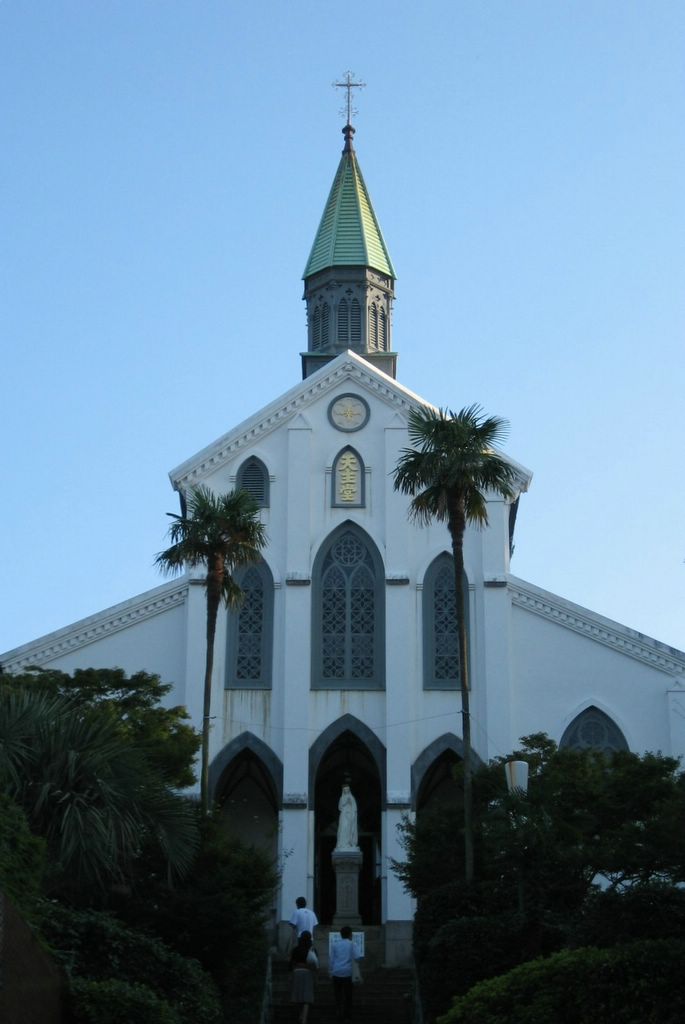
This is one of several churches which are dotted around Nagasaki - an unusual sight in Japan. Christianity flourished in secret here whilst the rest of the country was closed to the West.

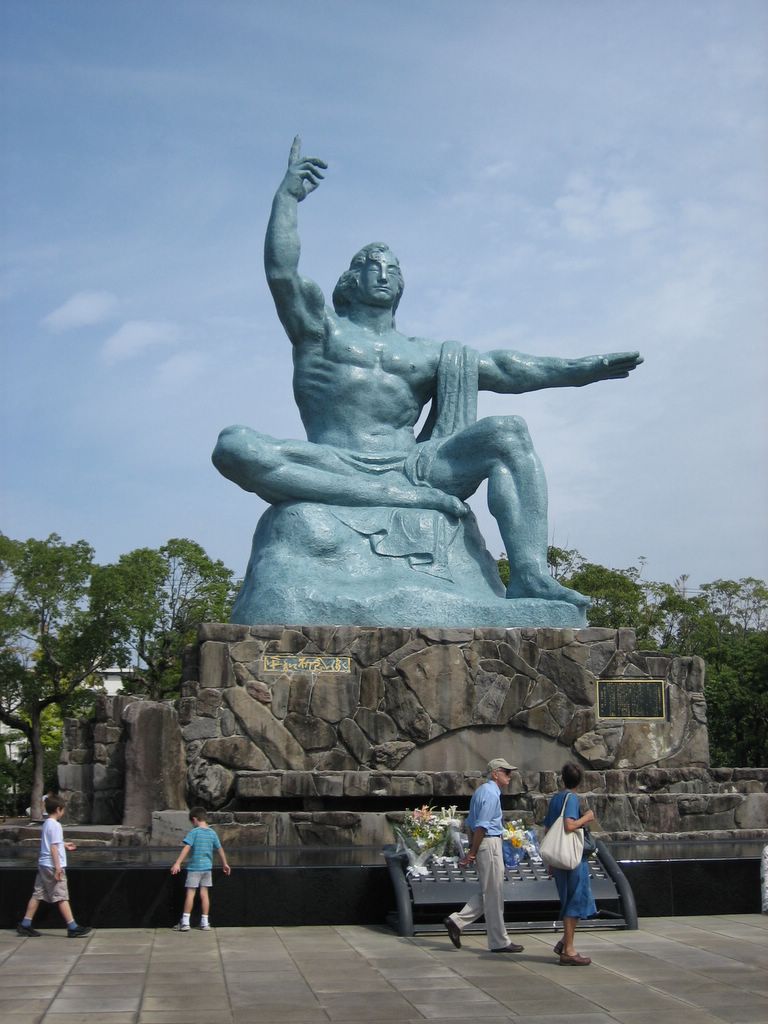
The symbol of the Peace Park in Nagasaki is this blue statue. Everything about the statue is symbolic of something: for example, the right hand pointing up warns of danger from the skies, whilst the left hand symbolises peace. Similarly, the curled right leg suggests calm and meditation, whilst the firmly planted left leg symbolises readiness for action in the defence of peace. All in all, pretty heavy stuff. Having said that, it does look a bit like he's directing traffic.

This black column marks the exact spot where the bomb detonated.

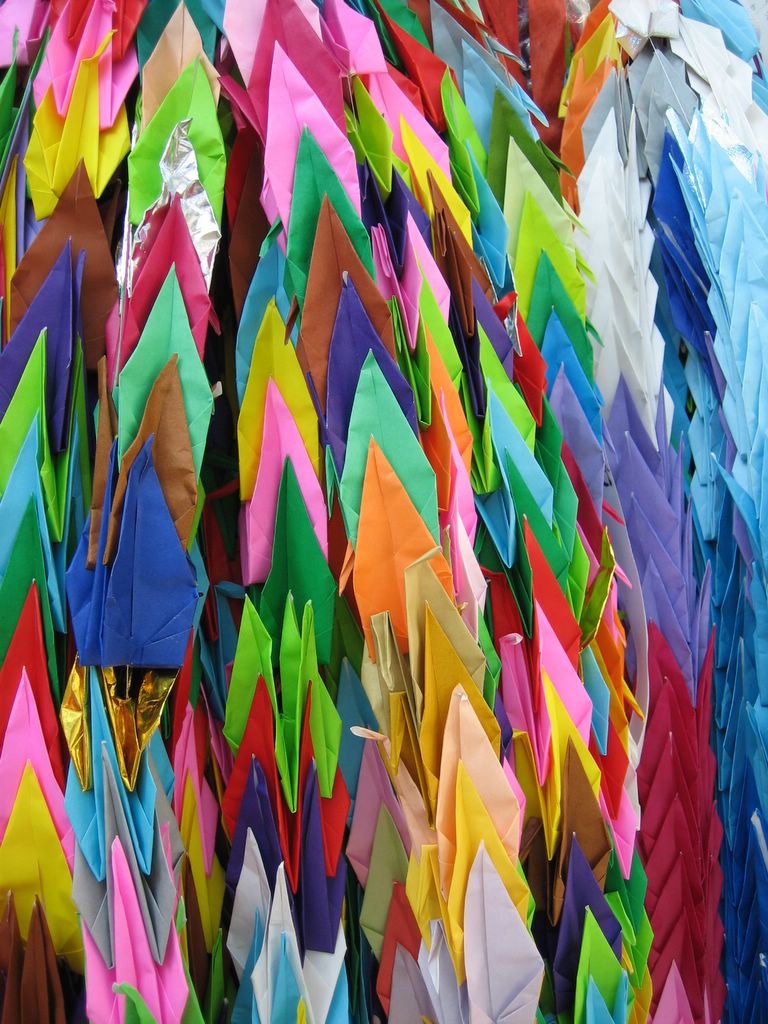
There are thousands and thousands of these colourful paper cranes placed around the Peace Park and museum. Making one thousand paper cranes is a symbolic gesture calling for peace or good fortune.

18 October 2005


"Ichigo Kurosaki is a 15-year old boy with an angry face. He also has the ability to see ghosts." The beginning of the plot synopsis on Anime News Network.com for the hugely successful manga series, "Bleach".

MANGA MANGA MANGA

I knew that comic books were popular in Japan before I came here, but
I never realised quite how massively popular they actually are. For
example, I never realised that students would be reading them under
their desks in class whilst I try to teach them English. Don't let
people tell you that all Japanese kids are ultra polite - in
comparison to British and American teenagers they're absolute angels,
but they still read and chat loudly with their friends in class, make
up excuses to go to the toilet so they can bunk out of lessons and
even fall asleep right there at their desk.

Actually, that last one happens quite a lot, and most of the Japanese
teachers don't seem to mind - they just let them lie there. I think
there's some sort of unspoken implication that if a student is so
tired that they fall asleep at their desk, then they must have been up
studying well into the early hours of the morning. Although in my
experience there's an uncanny correlation between the sleepers and the
kids I saw smoking behind the convenience store the other day. So I've
developed a new strategy - poking the little sods until they wake up.
I'm not sure if poking is necessarily the key to forming a strong
student-teacher relationship, but it sure is effective. I've also
instigated the "Sleepers' Hall of Fame" - every time a student falls
asleep at his or her desk I take a picture with my mobile phone and
stick it up in the library. That'll learn 'em.

Anyway, back to manga. The comic book culture is quite different here
from the UK. For a start it's quite normal for girls to be heavily
into manga, and there's a huge slice of the comic book market which
caters specifically to girls (see the girls' manga section below).
Comics are also incredibly cheap - huge second-hand stores like "Book
Off" deal almost exclusively in manga and sell most titles for about
100 yen - that's just 50p. Plus the average comic is usually over 100
pages long: huge compared to American comics, which usually only have
about 30 pages per issue for three or four times the price.

The down side is that pretty much all manga is printed in black and
white - hence its cheapness. As a result the artwork in Japanese
comics, although very admired, isn't fetishised as much as in American
comics: lavishly painted, double page picture spreads are fairly
common in America, but extremely rare in Japan. Consequently, comics
by famous American artists and writers tend to go up in value over
time, whereas the price of most manga tends to fall as it becomes more
"out of date". My students couldn't believe it when I told them that
the first issue of "Spider-man" could fetch hundreds and hundreds of
dollars at auction.

Manga has a surprisingly seedy underbelly too - nudity is pretty
common, but no one really seems to bat an eyelid. Having said that,
nudity seems pretty common in practically ever country other than
Britain and America, so perhaps it's just my Puritan outrage welling
up unnecessarily. There's something definitely creepy about the manga
toys though, particularly the scantily clad plastic models of girls.
There must be a huge market for them, because there's hundreds for
sale in all the second-hand shops, but I've yet to actually see
someone buy one. Maybe they come out after dark...

Actually, the shop assistants must have thought I was the creepy one,
since I was standing around for about 15 minutes trying to get good
photos of the naked plastic toys with my mobile phone. Suddenly I
heard an announcement over the speakers in Japanese and I swear I
heard the word "mobile", then when I looked round the till girls were
all giving me funny looks. "OK......this looks....dodgy", I thought.
How could I explain in Japanese that the photos were just web-related
research? Would they believe me? Well, you know what they say: "when
in doubt, peg it out of the shop as fast as you can and don't look
back in case they recognise you."

And I think we can all learn something from that.


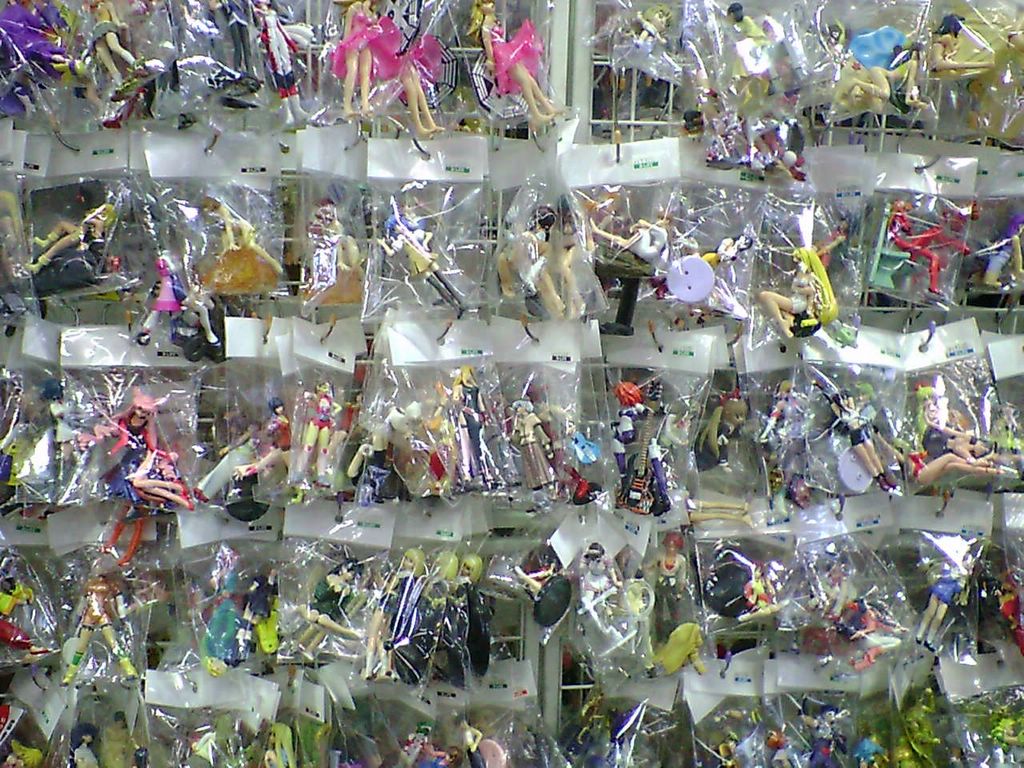
A selection of some of the manga-related toys for sale.

This entire aisle is dedicated to romance comics for young women.

Let's just say, it's a bit racier than Barbie.

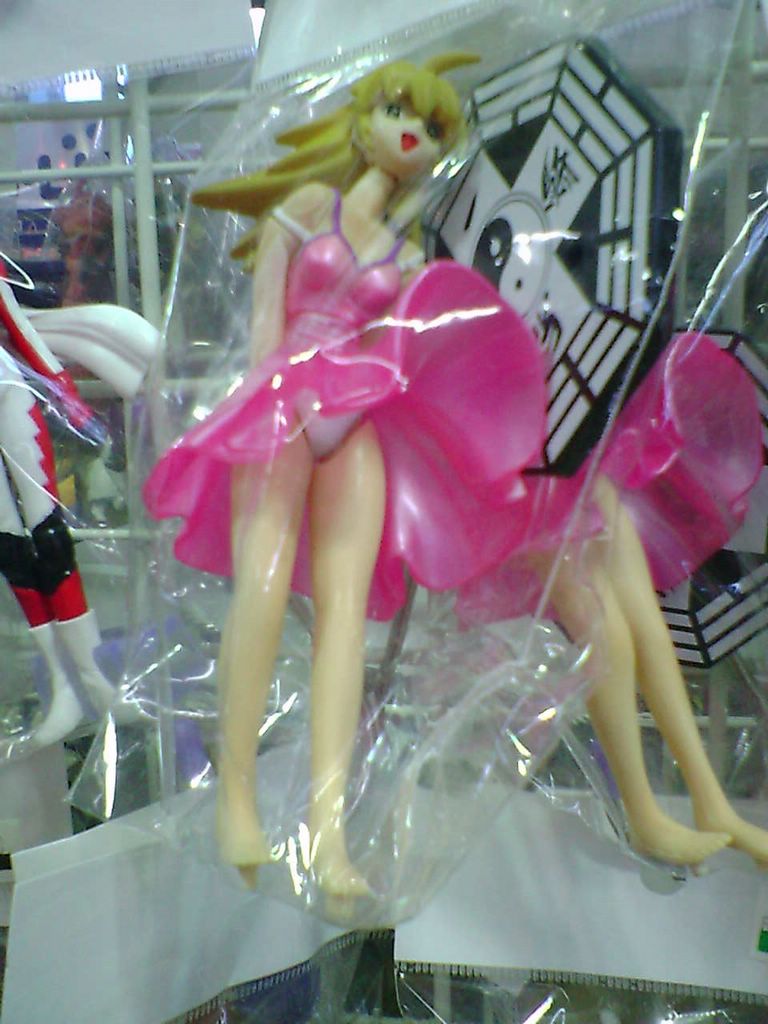
"Pesky wind. Good job I was wearing my ice white panties."

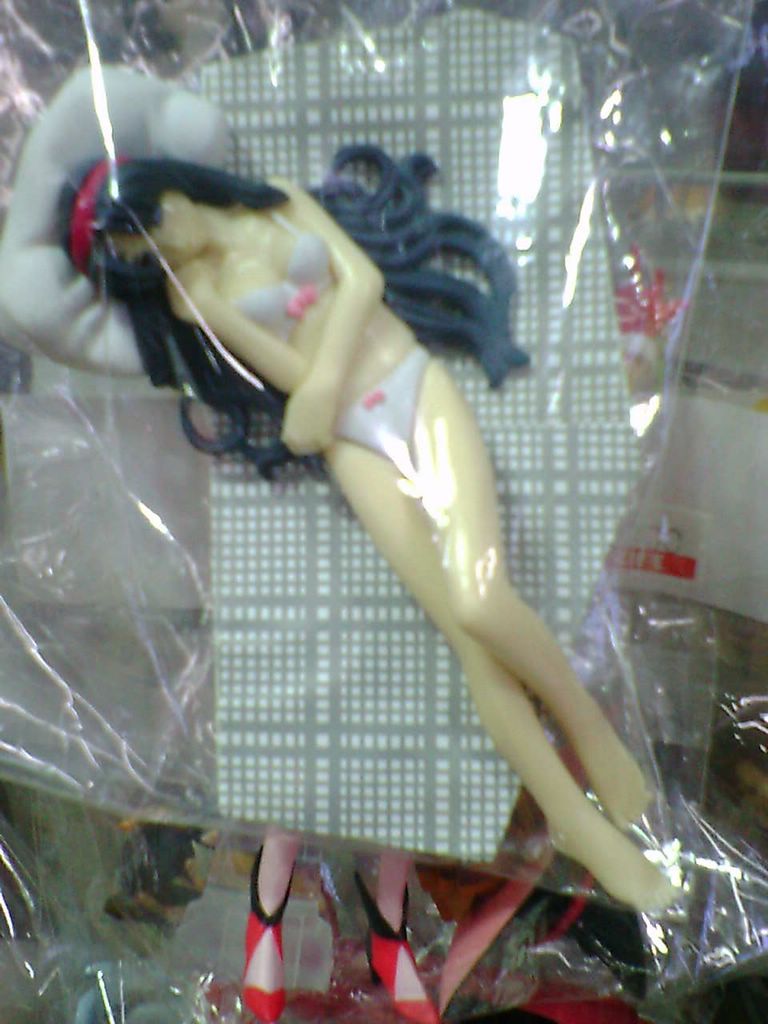
Perfect for Grandma's mantelpiece.

Engrish Engrish Engrish

I realised that I haven't put any Engrish pictures on my blog for
absolutely ages, so here's a few choice cuts, as it were. Let's enjoy
Engrish!!!


Cigarette vending machines are a great place to find Engrish... check out the one below too.

Buy cigarettes - good things will happen to you. Let's enjoy smoking!

Appropriately enough, one of the items that "Colon Booth" sells is "Asse Chocolate". Mmmmmm.

Not really Engrish this one - more like a nugget of wisdom for the uninitiated.

Oh! Autumn. Heavens! Winter. Oh Lordy Lord! Spring. Well cover me with lipstick and call me Susan! Summer.

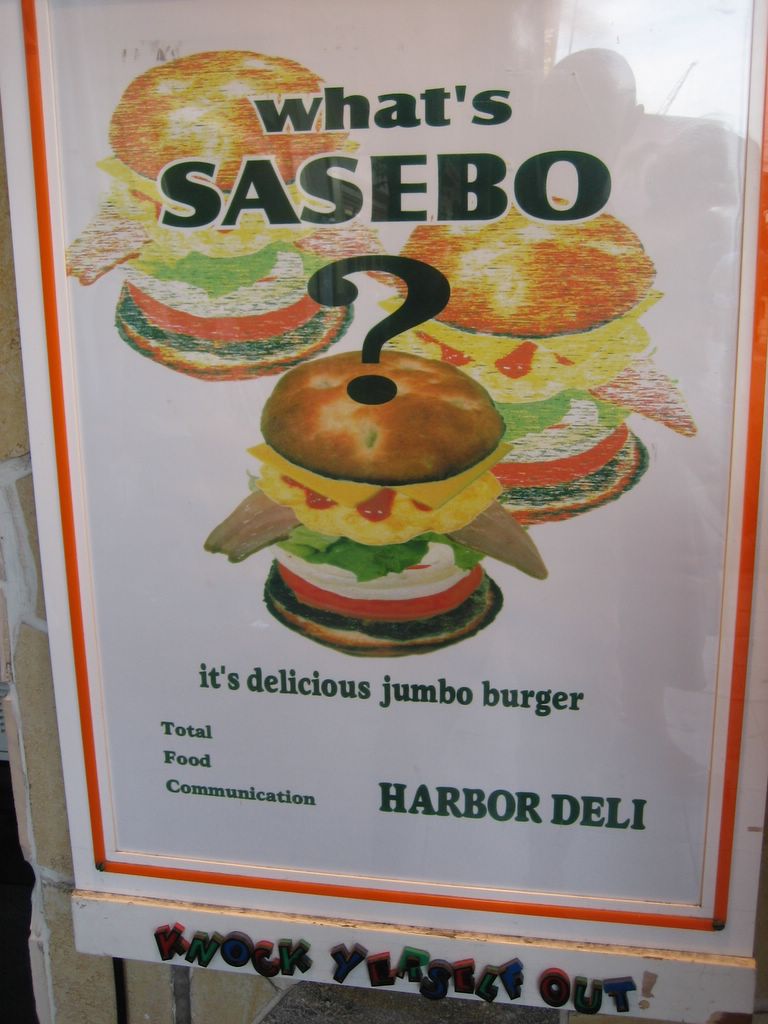
What's Sasebo? Why it's delicious jumbo burger of course! Although if you ask me they look more like an army of Daleks in disguise.

Ladies` fashions in Japan can be extreme at the best of times, but Lord knows what they sell in "SmackyGlam".

17 October 2005


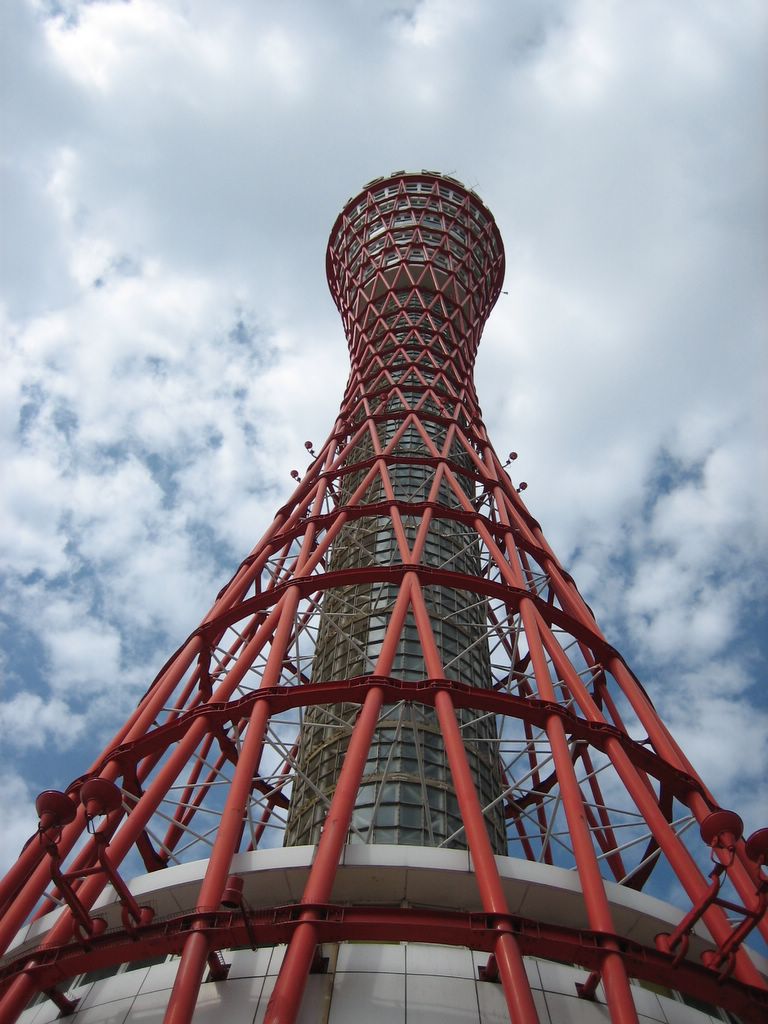
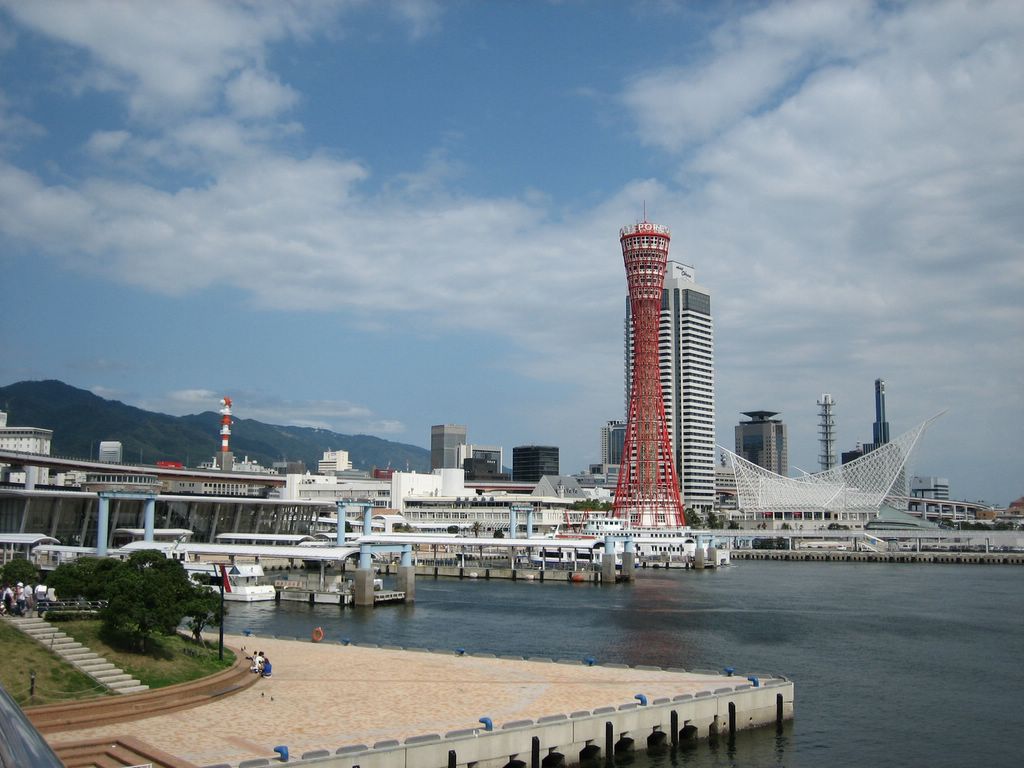
The Port Tower in Kobe.

Kobe

Kobe isn't usually at the top of most travellers "must see" lists. The
nearby cities of Kyoto and Osaka far outshine Kobe in terms of culture
and nightlife, so it's easy to see why most people rarely take the
trouble to make a trip into the Other Big K. Whilst Kyoto is famous
for its temples and Osaka is famous for its food and late night
clubbing culture, Kobe is probably most famous for the massive
earthquake that occurred there in 1995. Not exactly the greatest
advertisement for a city.

Having said that, I found Kobe to be one of the most enjoyable cities
I've been to so far. The very fact that it's not so popular with
tourists is one of its greatest assets - anyone who's joined the crush
of people straining to get a look at one of the famous temples in
Kyoto will know what I mean.

In terms of sightseeing attractions the city doesn't have a huge
amount to offer. There's a cable car which climbs the mountains behind
the city, as well as a "foreign quarter" filled with replicas of
mostly European houses, but we didn't have time to visit either of
these. Apart from that there's the Chinatown and the harbour and
that's...well, that's about it really.

So why did I enjoy it so much? I guess the atmosphere was a major
factor - it's just such a pleasant city to wander around. It's
difficult to describe exactly why, but I think the top class
restaurants, bars and shops have a lot to do with it. When it came to
eating out we were spoiled for choice, constantly stumbling across
great restaurants and bars. We even found an organic vegetarian cafe,
and I can't even begin to describe how rare a find that is in Japan.

I think if I was only visiting Japan for a short while I might be
disappointed by Kobe's lack of historical sights and its slow pace,
but as a long-term resident from deep in the Japanese countryside it
was a welcome change. In fact, it's one of the few Japanese cities I
wouldn't mind living in myself... mostly for the organic vegetarian
cafe of course.


Flick, Tilly and Laura take a rest by the waterfront.

Kobe harbour. The crazy white pointy building on the right is the maritime museum.

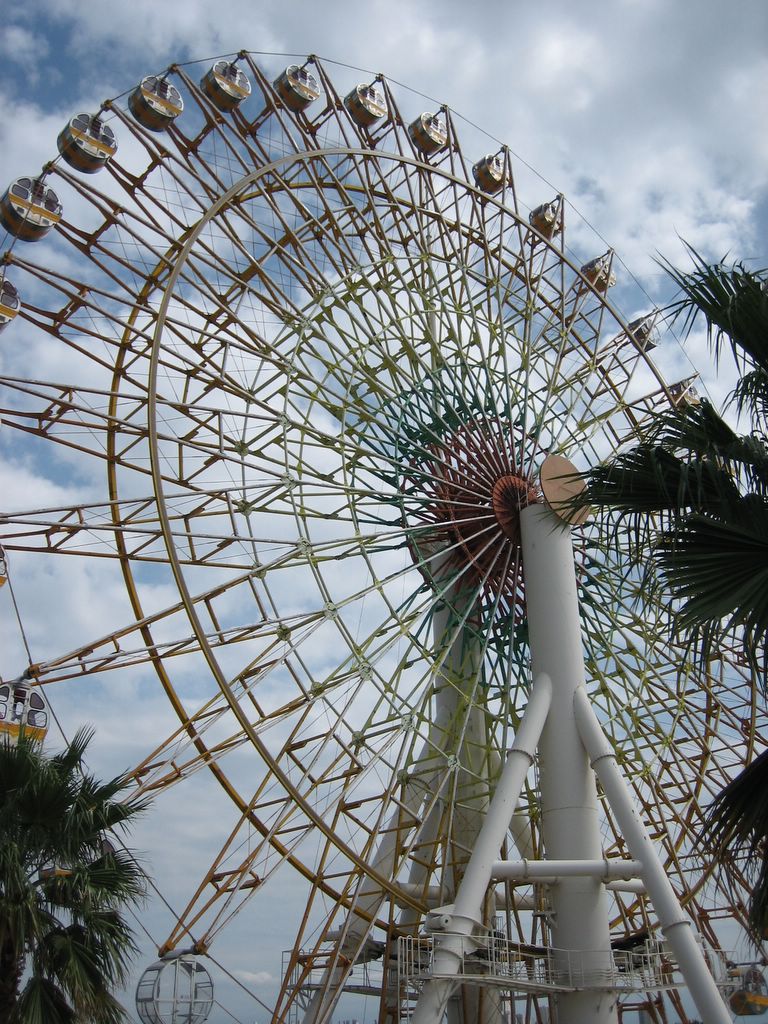
The ferris wheel. We were tempted to go for a ride but it was around 1000 yen for a "shee-furuu" (see-through, we eventually worked out) cabin. So we had a ride on a motorised giraffe next door instead (a bargain at just 100 yen). All good fun until I nearly ran over a stray child. Whoops.

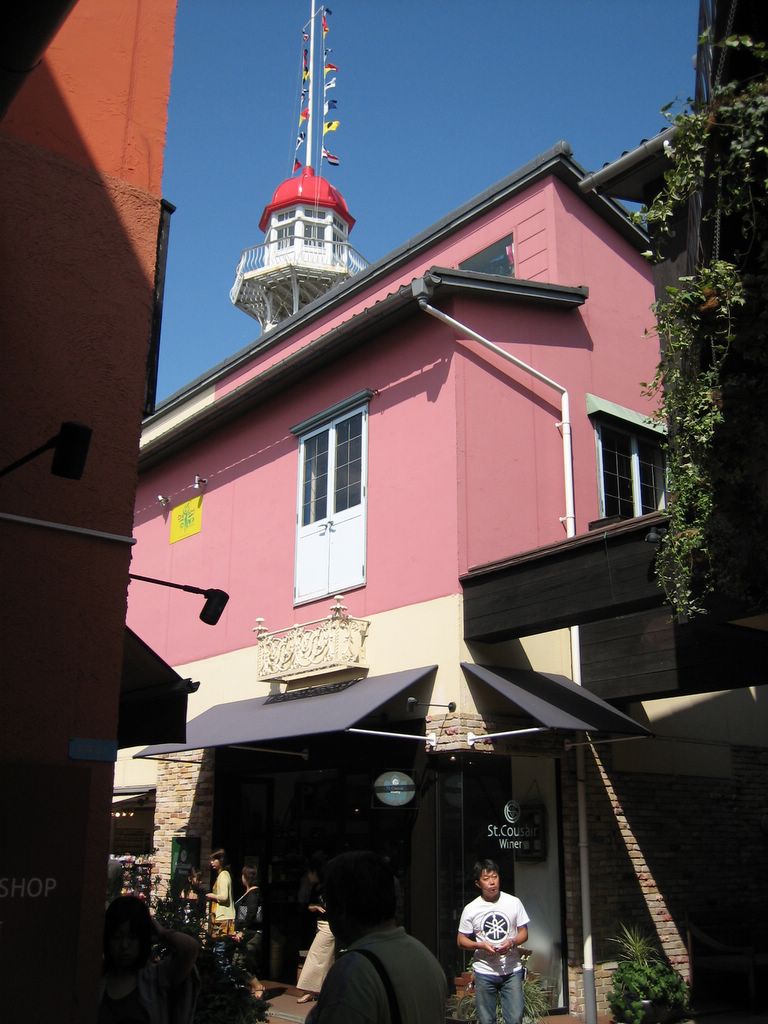
The harbour shopping mall was a pleasant place for an afternoon stroll - the whole thing had a homely feel that's missing from most shopping centres. And pink houses of course. You don't see many of those.

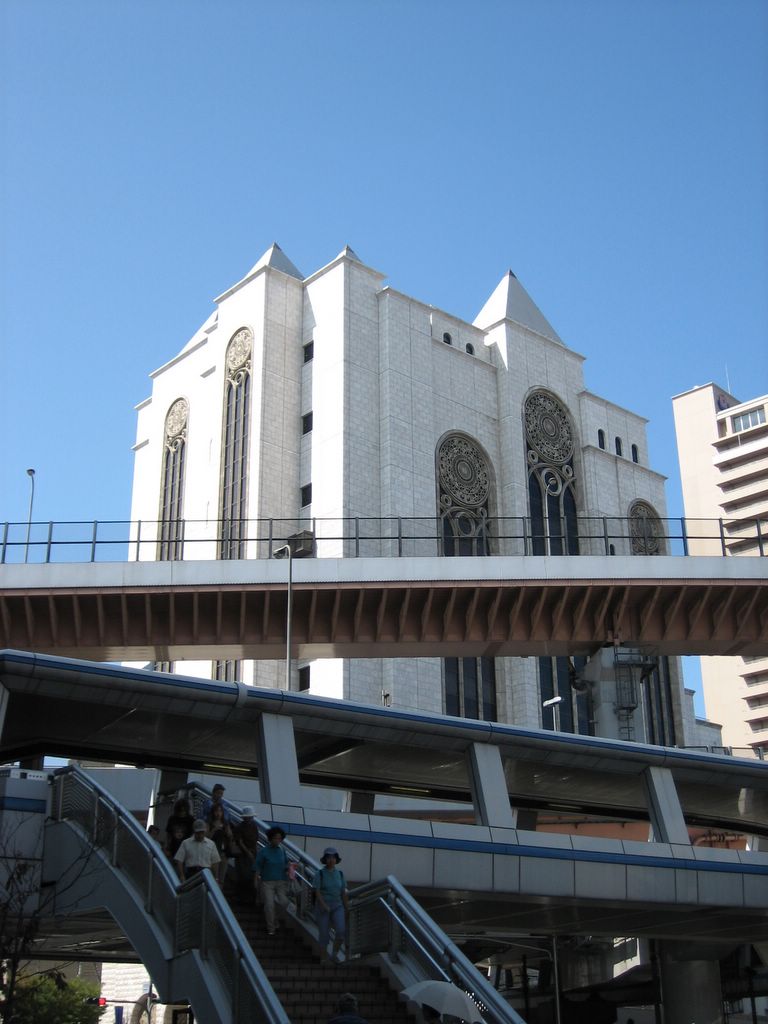
Peaking out from behind the expressway was this bizarre office building with Gothic-style windows. I'm still can't decide whether it's a daring attempt to try something new and different, or just a monstrosity.

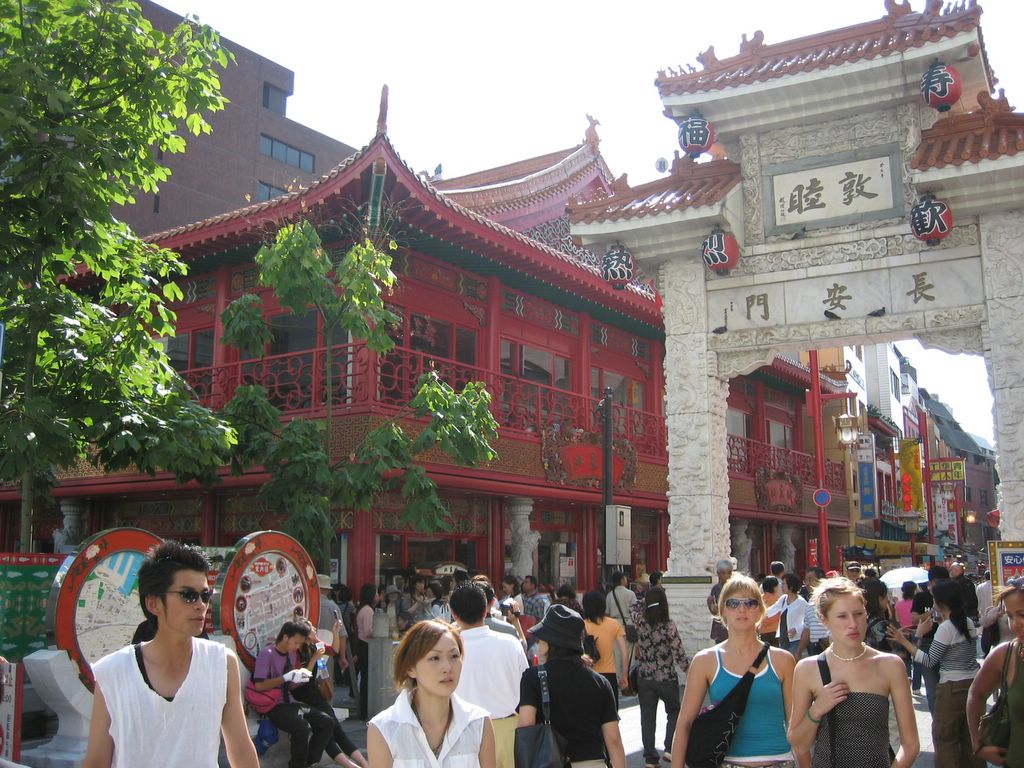
Kobe's Chinatown was definitely vibrant and bustling, but I felt it lacked a certain something. The streets were packed with stalls, but they all sold exactly the same Japanese variations of Chinese dishes.

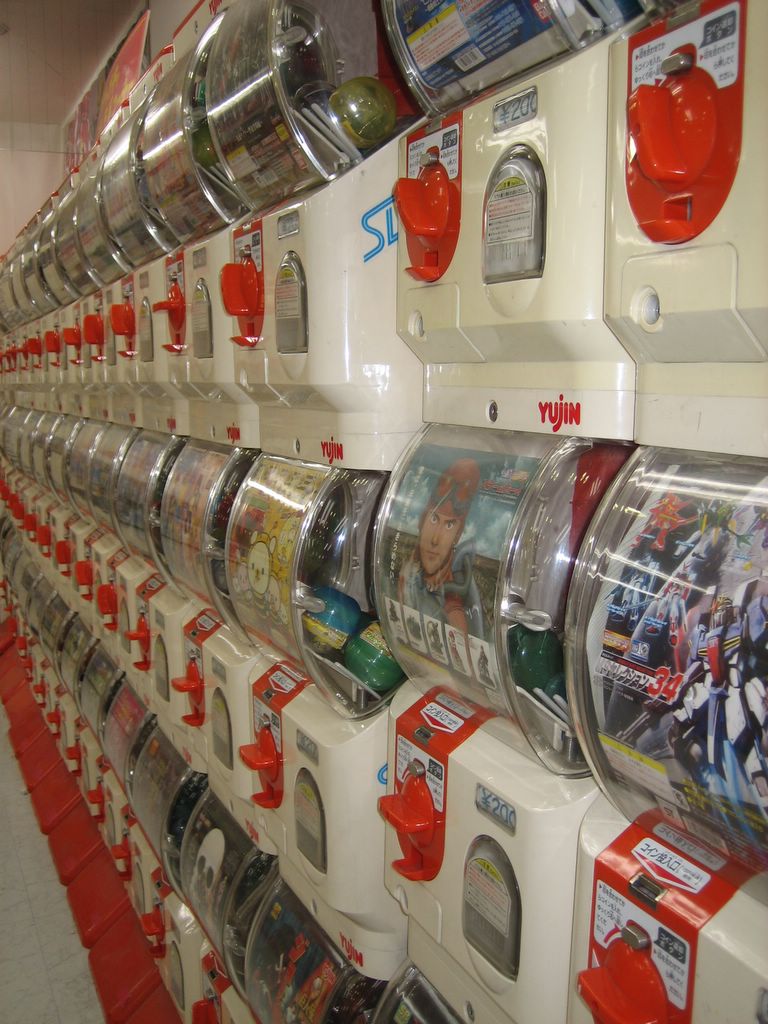
And look what I found hidden away in the corner of an underground shopping mall - an absolute treasure trove of capsule toy vending machines. "I love these!!!" (Name that quote...)

14 October 2005

Minor Annoyance

So I went to the supermarket last night after work to stock up on some
much needed food supplies. After a quick dash round the aisles I
arrived at the checkout and the beaming young lady at the till began
scanning my purchases. The total was 2,317 yen.

Now, if you live in Japan you probably know how annoying all the small
change can be, particularly the next-to-useless 1 yen coins. Pretty
much all the English teachers I know around here have an enormous jar
somewhere in their apartment brim-full of 1 yen coins which they can
do absolutely nothing with. The bank charges you to change them into
higher coinage, and it would be far too embarrassing to actually take
a sackload to the shop to buy something with them, so they just sit
there, unused. Consequently, I try and get rid of my small change
wherever possible.

In this case I wanted to pay with a 5000 yen note, but in order to
avoid being handed back a large pile of loose change I cunningly
fished out exactly 317 yen in coins from my pocket. Yes sirree, three
crisp 1000 yen notes were gonna be heading my way. The smug grin was
already forming across my face.

However, something was amiss. The beaming till girl had given me just
two 1000 yen notes, and had begun to count out mountains of change -
the transaction had gone very wrong. I looked up at the till screen
and to my horror I realised I'd forgotten to give her the ten yen coin
in my hand, and she'd begun counting out 2990 yen in change. Heavens
above!!! Quick as a flash I thrust the ten yen coin towards her with a
quick "sumimasen", but her reply almost knocked me to the floor: "[in
Japanese] I'm sorry, but the till says I have to give you 2990 yen in
change."

What?

She went back to counting out exactly 990 yen in small coins.

I was gobsmacked. Surely it would have been easier all round just to
give me a note? Was the till angry at me? Why was it making me suffer?
Several things occurred to me as I walked back to my car with the
massive ball of change chinking against my leg:

1) In Japan, the customer is always right. When I accidentally gave
her 2307 yen instead of 2317 yen the till girl automatically assumed
that I must have done it for a reason. Perhaps I just loved small
change, and would be ecstatic to receive 990 yen in small denomination
coins. Perhaps she thought I was going to a football match later and
needed lots of coins to throw at the referee. Or maybe she was just
too scared to tell me that I had given the wrong change because she
might have had to speak in English. Probably the last one I expect,
although I'd like to believe that she thought I had some sort of coin
fetish.

2) Although the customer is always right, the till has divine
supremacy over everyone and everything, and as such it MUST BE OBEYED.
Here endeth the lesson.

As I say, only a minor annoyance. But still annoying.
13 October 2005


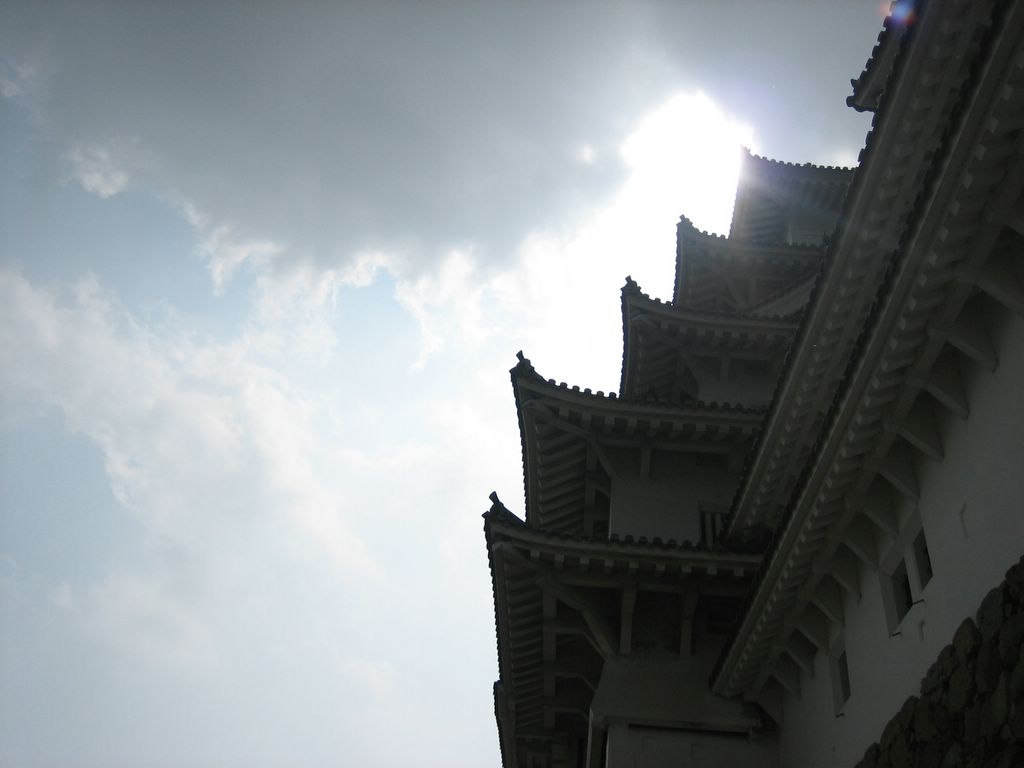
Himeji castle looms over the trees.

Himeji Castle

I went to Himeji castle in Hyogo prefecture a few weeks ago - and I was stunned. It's easy to grow cynical of Japanese castles, since usually they're constructed from concrete and are only a couple of years old. They may look pretty from a distance, but up close the moulded cement and tour guides makes them feel more like a Disneyland ride than a real piece of history.

Himeji is different. Although it's also been reconstructed several times in its history, the architects have thankfully shied away from the concrete route, and have instead re-used the original building materials where its been possible, as well as employing traditional construction techniques. The results are more than worth it - finally, a Japanese castle that feels like it's more than ten years old.

The other main difference from the other castles I've visited is the size. Himeji towers above the surrounding landscape, and the courtyard alone provides plenty of opportunity to explore before you've even reached the main building. The suicide quarter was particularly interesting - some people think that this area was where samurai would disembowel themselves if the castle was ever captured. Luckily for the samurai, Himeji has never fallen.
Right next to the castle is "Koko-en", a garden which was built in 1992 to commemorate the hundred year anniversary of the establishment of the Himeji municipality. In general I haven't been impressed with the Japanese gardens I've seen (see http://anenglishmaninnyugun.blogspot.com/2005/07/fake-plastic-trees.html) but, again, this was different.
 
For a start, it was quiet. The 9 neatly sculpted gardens were separated by a maze of walls and hedges, so that even when it was busy it was easy to feel like you were on your own. Plus all the gardens had a different theme, such as the "bamboo garden" and the "tea garden", which meant I never reached the dreaded stage of "garden fatigue" (similar to the oft-mentioned "temple-fatigue", but in this case the victim develops a sort of temporary blindness where he or she no longer has the capacity to appreciate yet another delicately trimmed shrub or tastefully sculpted pond).
 
Koko-en may not be on any top five list of gardens in Japan, but as far as I'm concerned it was the best one I've seen, and I'd definitely recommend it over the more famous, but ultimately slightly-disappointing Kenroku-en in Kanazawa. Koko-en may only be a few years old, but the thought that's been put into it more than makes up for the lack of history.

The approach to the main tower. The castle is surpisingly huge - we spent a good hour just walking around the grounds without even going inside.

Part of the main courtyard. The building on the left is a food storehouse.

The charmingly-named "suicide quarter", where it's believed that dishonoured samurai would commit "hari-kiri".

Looking up at the main tower.

Flick at the entrance to Koko-en.

The main garden.

Koi and a waterfall. Yep, it's a Japanese garden alright.

04 October 2005

The Dessert of Salvation

(This is an article I wrote for the Fukui JET magazine, JETfuel.)

There was no way to ignore it. We both blinked our eyes in disbelief. Could we really be seeing this? We continued to blink our eyes in disbelief. It wasn't going away. And all the blinking was starting to affect my driving. As we drifted lazily toward the central reservation, our eyes streaming with water, we came to accept the truth: we were heading straight toward a giant banana split.
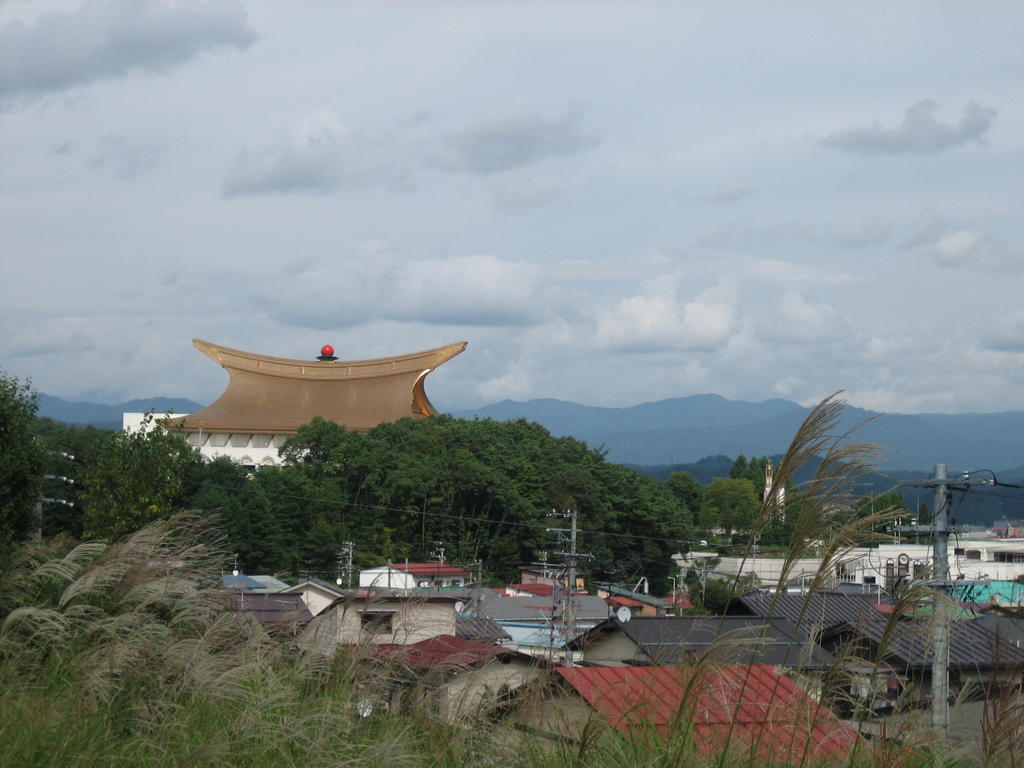
My good lady friend Flick and I were on the outskirts of Takayama in Gifu prefecture, around 3 hours drive from our beloved Fukui-ken. We'd been intrigued by the guidebook descriptions of a picturesque, unspoiled Japanese town nestled in the mountains of Gifu, so we decided to take advantage of the long weekend and head out there. The picturesque, unspoiled streets certainly weren't disappointing. Unfortunately the several picturesque, unspoiled streets happened to be surrounded by a tangle of ugly, concrete streets much like every other Japanese town, so we found that we'd seen everything there was to see in about an hour.
That is, everything except the giant banana split we'd spotted on our way into the city, which on closer inspection had turned out to be an enormous and hideously tacky banana-shaped golden temple. With a cherry on top. We had some time to kill so we decided to check it out.


The eye-streamingly garish place of worship turned out to be owned by a cult (sorry, "religious sect") called Sukyo Mahikari, who had built the "Main World Shrine" or "Suza" to enshrine "the Creator, Su God", and to serve as "the source of the Light of God for the world". Oh, and apparently it's the "foundation for the salvation of humankind" as well. Which is nice.

It's difficult to describe the feeling of walking up the megalithic steps to the entrance of this banana-shaped summer palace for God. I felt a bit like James Bond infiltrating the inner sanctum of some cat-stroking super-villain. Any second I expected armies of ninjas to vault over the walls and surround us, before some pasty-faced bloke with an East European accent and a limp shuffled out of the main doors laughing maniacally.

"Congratulations Mr. Bond , you have found my secret lair. Most… impressive. However, you will find you are too late to save the world!!! Come my ninjas! Attack!!!"


(Ninjas not pictured)

The décor is truly bizarre – in true post-modern style the designers seemed to have borrowed something from every world religion, including an Aztec-style "Quetzalcoatl Fountain", Islamic-style minarets, Buddhist-style entranceways, and to cap it all off everything is covered with the symbol of Judaism, the Star of David. It gets even stranger inside – the enormous golden altar is trimmed with a tropical fish tank which extends from wall to wall, and the central shrine is set in a diorama of fake cliffs and plastic trees, making it look like some sort of theme park ride. No animatronic pirates though.

I have to say I was impressed with the place – it was as strange as it was alarmingly tacky. But it was huge too (the main hall can seat 10,000 people) and it made me wonder where on earth they came up with the money to build it all. Was it really owned by a James Bond-esque super-villain? Did he have a cat?

A quick trawl through the internet showed that the cult of Sukyo Mahikari is surprisingly widespread. Their headquarters are in Takayama, but they have offices in Luxembourg, California, Brazil, Australia and Singapore, and an estimated membership of up to 500,000 , although given figures vary widely and the true number is probably much less than that . Every member is expected to make a "contribution" to the religion, but it's unclear exactly where all the money goes to, although I'm sure the construction of the shrine in Takayama must have cost a pretty penny. There are some pretty weird stories surrounding the group too...

The cult was founded in 1960 by a man named Yoshikazu Okada, who was a "lieutenant colonel and strategic planner" in the Japanese attack against Nanking in 1937; the brutal attack which became known to the world as the "Rape of Nanking". After the war Okada became a member of the Church of Messianity, whose gospel teaches that suffering results from "dust that accumulates on the soul". In 1959 he experienced a revelation at 5 in the morning when the Su God, or "True God of Light", promised to unleash a "Baptism of Fire" which would heal his followers and destroy non-believers. Scary stuff. And the date for this apocalyptic event? 2000AD. Obviously the Su God forgot to wind his watch.

In its early days the sect was known as "Lucky and Healthy Sunshine Children", but this quickly changed to the slightly less catchy "Mahikari". The main basis of the religion is a sort of "light healing", where the practitioners try to radiate the "True Light of God" from their hand in order to heal the "impurities of the body and soul". The shrine's pamphlet boldly claims that: "Even the poisons nowadays found in food and in the environment can be purified by this powerful energy".

In 1978 Mahikari split into two factions after a crisis of succession caused by the death of its founder, Okada, in 1974. After a court battle a senior member of Mahikari, Sekiguchi Sakae, took control of the movement, whilst Sukyo Mahikari was formed by Keishu Okada, Yoshikazu Okada's adoptive daughter.

One of the aims of Mahikari was to build a "Main World Shrine" to enshrine the Su God itself. Sukyo Mahikari did this in 1984 with the construction of "Suza" in Takayama, and in 1987 the other faction of Mahikari led by Sekiguchi Sakae constructed an even larger shrine on the Izu peninsula in Shizuoka prefecture, which they called "Su-Za" (spot the difference?).

Now it gets interesting. According to Andris Tebecis in his book MAHIKARI: Thank God For The Answers At Last, "A shrine is not merely a place of worship or a place held sacred, although the word is often used in this context by people unfamiliar with such things. To enshrine means to establish a dwelling-place or physical structure for communicating with the entity or spirit enshrined. "

So where is the Su God enshrined? In Suza or Su-Za? But I digress…

He continues: " I learned that since the Divine era millions of years ago, only once in the history of humankind has there been an attempt to enshrine the Creator God - that by the ancient Jews. Through Moses the Jewish people received the command to build a special Temple for Almighty God."

"Eventually David's son, Solomon, was provided with sufficient material wealth to build the Temple. Unfortunately, however, he did not quite achieve this mission. Although he did build the Temple, misled by his wives he forgot the God Jehovah and allowed other deities to be enshrined in Jehovah's place. Consequently, Jehovah destroyed the Temple after Solomon's time."

"Sukuinushisama (founder Yoshikazu Okada, also known as Kotama Okada) said that the bad karma of the Jewish people for failing this mission is the very reason why they have been persecuted to this day."

So now you know.

He carries on: "Just as Moses once received the mission to build a Temple for Jehovah, Sukuinushisama received the mission to establish a Shrine for Su God. Just as all the Jews inherited the mission of Moses, we have inherited Sukuinushisama's mission."

The "Mahikari Exposed" website goes on to say that official Mahikari documents state that followers of the religion are the "true Levites" and the "tribe most favoured by God". In other words the Mahikari members are the "true Jews" – hence their Star of David symbol.

The group also believes that Jesus Christ actually died in Japan at the age of 106, and his burial place is in a village called Herai in Aomori prefecture. Which will be news to a lot of people. (You can see a photo of His alleged resting place below)


However, there's an even stranger cult (ahem, sorry again, "religious sect") a lot closer to home. "Pana Wave Laboratory" are a group of people who believe that electromagnetic waves are causing environmental destruction, so they sought out a place as far away from "polluting" electromagnetic waves as possible – the mountains of Fukui.

If you thought the ideas of Sukyo Mahikari were a little odd you'll be amazed at the beliefs of Pana Wave devotees… The group was formed in 1977 by an English student and part-time streaker called Yuko Chino, and it teaches a mixture of Buddhism, Christianity and New Age doctrines. They also believe that " electromagnetic attacks are being carried out by communist guerrillas who have dispersed around the world following the break up of the Soviet Union".

Hey, it could happen.

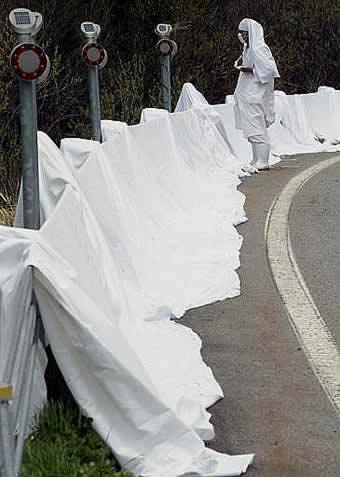
The group made headlines on 25 th April 2003 when they took over a 200 metre stretch of road in Gifu prefecture, covering up trees and roadside barriers with white cloths. They claimed that their guru, Yuko Chino, had come under attack from electromagnetic waves and that it was dangerous to move her. When confronted by TV reporters they claimed the TV cameras were emitting dangerous "microwaves", but after a week-long stand-off they were eventually moved on by police.


The group believes that white cloth can reflect electromagnetic waves and so they dress from head to toe in white, even wearing white surgical masks. I first came across Pana Wave last year when I was driving down the Echizen coast road and found myself following a convoy of white 4x4s. Intrigued, I followed them into the mountains and caught a glimpse of their encampment – obvious because of the numerous white sheets draped over the surrounding trees. In the past they've even tried to cover up a stretch of riverbank in white cloth next to their headquarters in the Gotaishi district of Fukui city, until the prefectural government ordered them to remove it all.

The group also believe, or should I say believed, that the world would end on the 15 th May 2003, stating that the 10th planet of the solar system would approach the Earth, causing disaster as the North and South poles switched polarities. Needless to say, it didn't happen, and presumably there were a lot of red faces all round.

Pana Wave officially has about 3,000 members, but the true number is believed to be a lot lower, possibly 1,200. However, in the 10 years prior to 2003 they are believed to have received around 2.2 billion yen in donations, 300 million of which was used to feed birds such as tobi kites and crows, according to police.

It's good to know that there are such interesting people living so close by.

 
Sources:
The Rick A. Ross Institute
Mahikari Exposed
http://www.forteantimes.com/articles/173_panawave.shtml
http://religiousmovements.lib.virginia.edu/nrms/mahikari.html